Any layer HDI is an abbreviation for ‘Any layer High Density Interconnect’ and represents one of the most advanced forms of HDI PCB technology, embodying the most cutting-edge interconnect architecture currently found in high-end electronic products. Any layer HDI refers to a multilayer HDI PCB in which all layers utilise laser-drilled microvias for interconnection.
From a terminological perspective, ‘Any-layer’ means ‘any layer’, whilst ‘HDI’ is the abbreviation for ‘High Density Interconnect’. Together, these terms precisely highlight the core of the technology: achieving direct interconnection between any two layers of the circuit board, thereby breaking through the limitations of inter-layer interconnection found in traditional PCBs and standard HDI. Essentially, Any layer HDI utilises process innovations to construct a circuit interconnection system characterised by “no layer constraints, high integration, and efficient transmission”, providing high-end electronic devices with optimal space utilisation and signal transmission performance.
From the perspective of technological evolution, Any layer HDI represents a significant advancement in HDI technology. Traditional HDI employs a ‘core board + outer layer lamination’ architecture, where interconnection paths are constrained by the fixed pairing of the core board layers and outer layers, allowing only limited interconnections between ‘outer layers and inner core boards’ or ‘between inner core boards’, resulting in obvious hierarchical constraints.
Any layer HDI, however, completely abandons this fixed model. Through a layered construction process, it creates a circuit structure characterised by “layer-by-layer stacking and arbitrary connectivity”. Whether between surface layers, between a surface layer and any inner layer, or between inner layers, interconnection channels can be established directly without relying on core boards as intermediaries. This ‘hierarchy-free’ interconnection characteristic liberates circuit layout from the constraints of physical structure, achieving ‘shortest’ interconnection paths and ‘optimised’ circuit layout.
In terms of application positioning, Any layer HDI is not a general-purpose PCB technology, but rather a specialised solution designed to address the pain points of ‘high integration, small form factor, and high-speed transmission’ in high-end electronic devices. It is primarily designed for scenarios demanding the utmost in PCB space utilisation, signal transmission efficiency and reliability, such as flagship smartphones, high-end smart wearable devices, AR/VR equipment and precision medical instruments.
The emergence of this technology has broken through the limitations imposed by traditional PCB technology on the upgrading of electronic devices, making product designs featuring “smaller form factors, greater functionality and higher speeds” a reality.
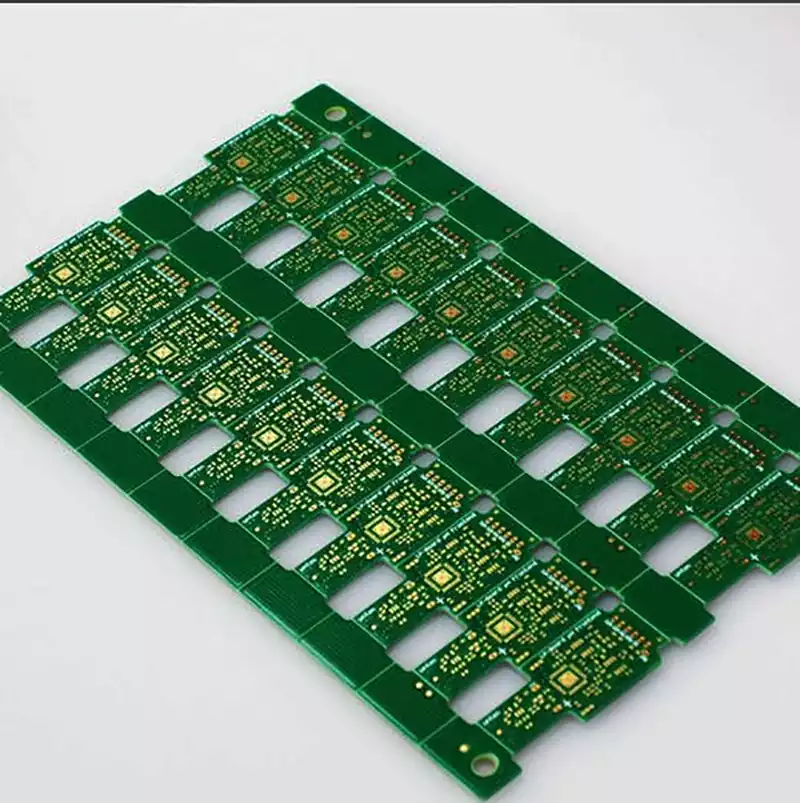
The “any-layer interconnection” capability of Any layer HDI is not achieved in a vacuum, but relies on the synergistic support of two core processes: laser micro-blind-buried via technology and the laminate manufacturing process:
1.Laser Micro-Blind-Buried Via Technology
The miniaturisation of interconnection channels is a prerequisite for achieving high-density interconnection, and laser micro-blind-buried via technology is the key process underpinning the implementation of Any layer HDI. Traditional PCBs primarily rely on mechanical drilling to form interconnect holes. Due to limitations in equipment precision and processing methods, hole diameters are typically 100 μm or larger, and are predominantly through-holes that penetrate the entire board.
Such through-holes not only occupy a significant amount of space within the board but also cause significant disruption to trace continuity and layout integrity. Although standard HDI has introduced laser drilling processes, hole diameters generally remain within the 60–80 μm range. Furthermore, the number and positioning of blind and buried vias are constrained by the ‘core board + layer-up’ structural framework, resulting in limited interconnection flexibility.
Any layer HDI, however, utilises higher-precision laser drilling technology to further reduce the diameter of blind and buried vias to 30–50 μm; some advanced processes can even achieve ultra-small diameters of approximately 20 μm, a scale equivalent to just one-quarter of the diameter of a human hair. More importantly, laser drilling allows for precise control over hole depth and positioning.
It can flexibly create blind vias that connect only the surface layer to a specific inner layer, or buried vias that interconnect only between inner layers, without damaging the circuits on other layers. This highly controllable method of miniaturised interconnection increases the number of interconnect holes that can be arranged per unit area to more than three times that of traditional structures, providing a solid foundation for ultra-high-density routing.
Furthermore, as a non-contact machining process, laser drilling avoids the risks of stress concentration and micro-cracks associated with mechanical drilling, thereby helping to enhance the overall structural stability and long-term reliability of the circuit board.
2.Laminated Manufacturing Process
Whilst laser micro-blind-buried via technology addresses the challenge of making interconnect channels ‘smaller’, the laminated manufacturing process fundamentally resolves the long-standing issue of ‘layer limitations’ in multi-layer interconnections. Traditional PCBs and standard HDI typically follow a manufacturing approach of ‘first fabricating the core board, then laminating the outer layers on both sides’.
The number of layers and the distribution of circuits on the core board are fixed at the initial stage, and subsequent interconnections can only be developed within the predetermined structure, exhibiting a distinct ‘structure-first, interconnection-constrained’ characteristic. In contrast, Any layer HDI, by introducing the lamination process of “layer-by-layer construction and interconnection”, achieves a fundamental shift from design logic to manufacturing methodology—namely, planning interconnections first and then constructing the layered structure as required.
From a process perspective, the lamination method can be understood as a highly standardised cyclical process: a single-layer circuit serves as the initial substrate, over which an insulating medium is applied; micro holes are then formed at designated positions via laser drilling; these holes are subsequently filled with metal via electroplating to establish electrical connections between the current layer and the new circuit layer; once interconnection is complete,the formation of the next layer of circuits proceeds. The aforementioned steps—‘circuit formation, insulation coating, laser drilling, and metallisation interconnection’—are repeated continuously, allowing the circuit board to be built up layer by layer and gradually take shape.
Under this manufacturing model, each layer of circuitry possesses a high degree of independent design freedom. Any two layers can be directly interconnected via precisely controlled drilling and metallisation processes, completely freeing the design from the constraints on interlayer interconnection paths imposed by traditional core board architectures.
Furthermore, as the lamination method reduces or even replaces the need for multiple full-board lamination processes, interlayer stress is significantly reduced, effectively minimising structural risks such as delamination and cracking, thereby further enhancing the overall performance of Any layer HDI in high-density, high-reliability applications.
Key differences from traditional HDI
| Comparison criteria | Traditional HDI | Any layer HDI |
| Inter-layer interconnection | Adjacent outer layers only | Any layer to any layer |
| Via structure | PTH + microvia hybrid | All-microvia structure |
| Routing flexibility | Limited by core layers | Approaching IC-level interconnection |
| Process complexity | Moderate | Extremely high |
| Cost level | Relatively high | Very high |
Key Advantages of Any layer HDI
Maximised routing flexibility
Designs are no longer constrained by the positioning of through-holes and core layers, making it easier to plan complex high-speed signals.
Significantly reduced board size and thickness
Ideally suited for ultra-thin, ultra-high-density products.
Superior electrical performance
Short microvia lengths and low parasitic parameters facilitate high speed, high frequency signal transmission.
Support for advanced packaging configurations
Meets the interconnection requirements of high-I/O SoCs, APs and RF modules.
Future upgrade directions for Any layer HDI
As the functionality of high-end electronic devices continues to evolve, Any layer HDI technology is also advancing towards greater precision, higher efficiency and greater environmental sustainability. Three core upgrade trends are expected to emerge in the future.
Firstly, breakthroughs in ‘ultra-miniaturisation’. Currently, Any layer HDI can achieve a hole diameter of 20μm and a line width/spacing of 15/15μm. In the future, the industry will aim to achieve a 15μm hole diameter and a line width/spacing of 10/10μm, further enhancing circuit density and space utilisation to meet the demands of higher-integration chips. This breakthrough relies on more precise laser drilling technology and more advanced electroplating processes. The industry has already begun research and development into deep ultraviolet laser drilling technology to achieve precise machining of even smaller apertures.
Secondly, ‘multi-layering’ and ‘multi-functional integration’. To meet the interconnection requirements for a greater number of functional components, the number of layers in Any layer HDI will be upgraded from the current 8–12 layers to 16–20 layers. At the same time, passive components such as buried resistors and capacitors will be gradually integrated, achieving the unified integration of ‘PCB + passive components’ and further reducing the size of the equipment. For example, embedding resistors and capacitors directly within the PCB’s insulating layers can reduce the number of surface-mounted components and enhance the compactness of circuit layout.
Thirdly, there is an upgrade towards “green and environmentally friendly” practices. Driven by global “dual carbon” targets, environmental requirements in the electronics manufacturing industry are becoming increasingly stringent. Any layer HDI will gradually adopt eco friendly processes and materials,such as cyanide-free plating, low-VOCs solder mask inks and biodegradable insulating materials, to reduce pollutant emissions during production.At the same time,the industry will strengthen the resource recovery of PCB production waste, improving the recycling rate of solid waste such as waste substrates and copper slag,thereby promoting the green and sustainable development of Any layer HDI.
Any layer HDI represents the culmination of HDI technology’s evolution towards extreme integration and free interconnection.Essentially,it utilises a fully micro-via, fully stacked structure to overcome the layer limitations of traditional multilayer PCBs, providing high-end electronic products with interconnection capabilities approaching semiconductor-grade standards.