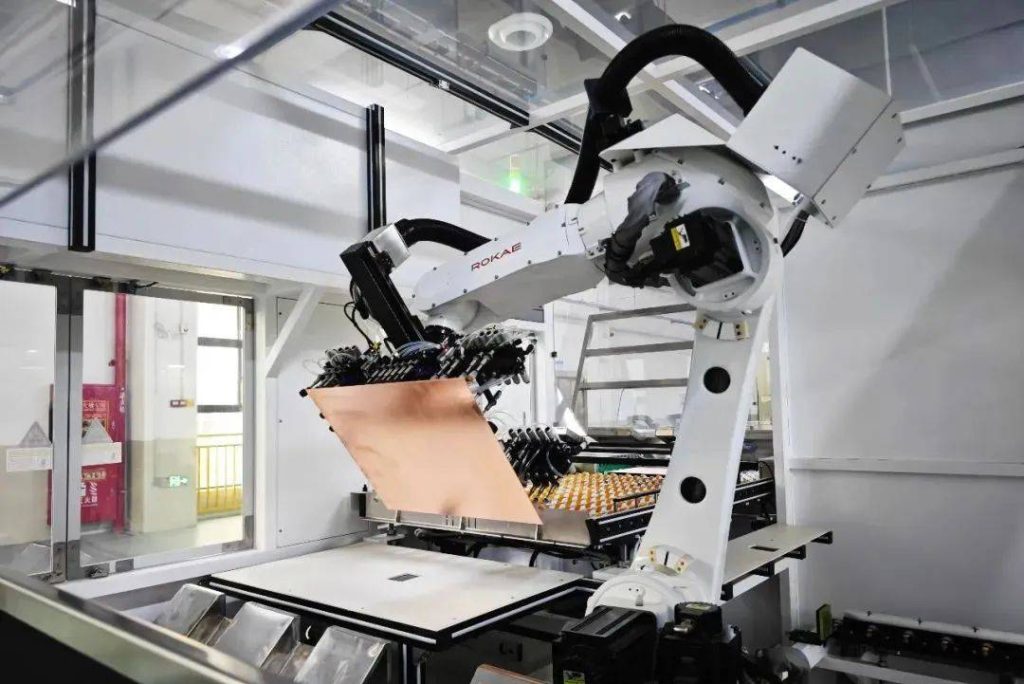
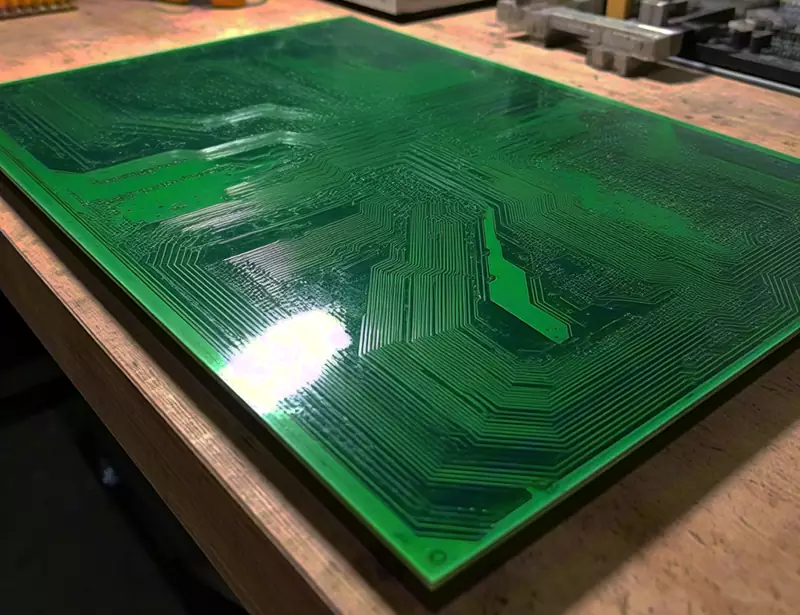
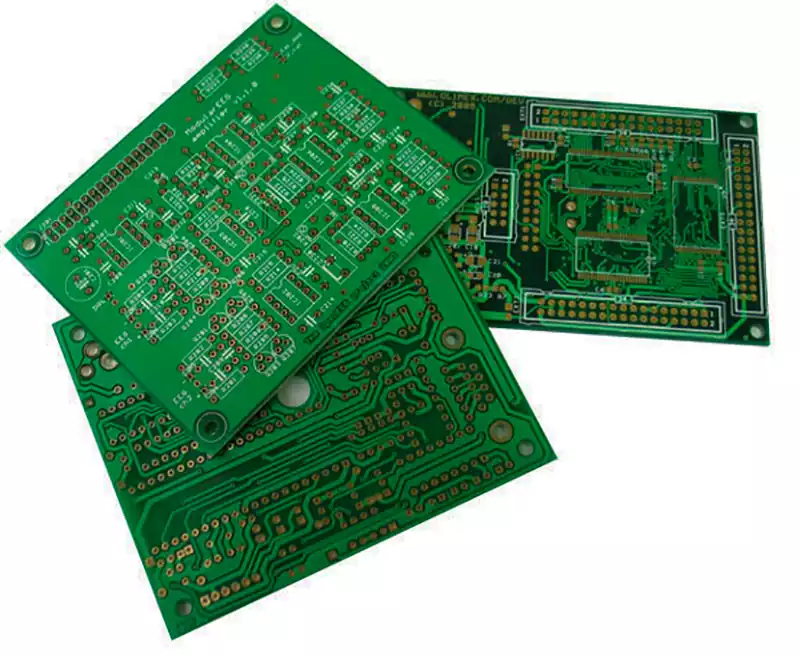
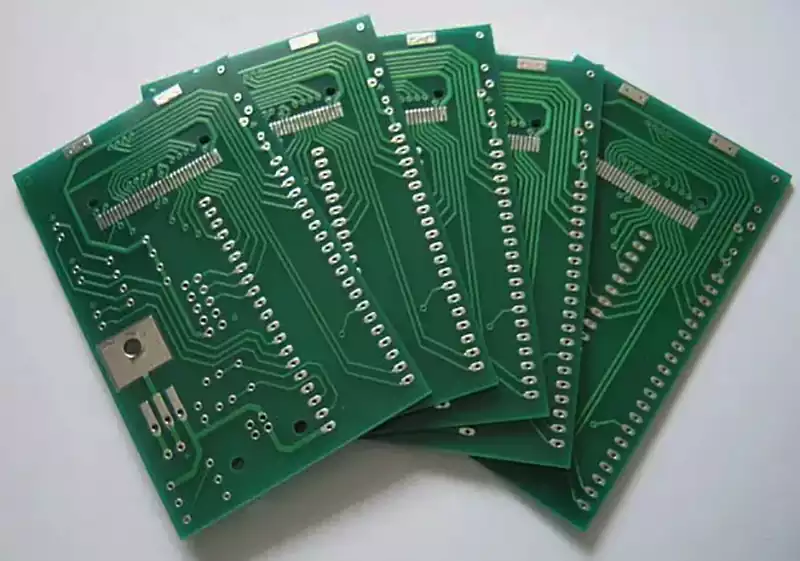
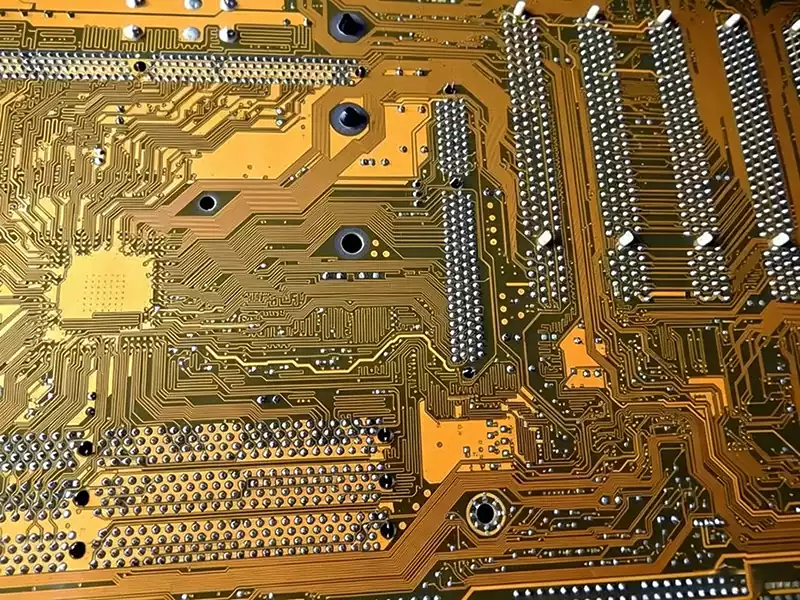
A gold plated pcb board is a circuit board on which a nickel-gold coating is deposited onto the surface of the copper foil via electroplating. The primary purpose of this process is to enhance the board’s wear resistance, corrosion resistance and electrical conductivity, whilst optimising high-frequency signal transmission performance.
Principles of the gold plating process
The gold-plating process primarily involves the electroplating of a layer of gold onto the surface of the PCB board. In the electroplating cell, the PCB serves as the cathode and gold as the anode. In an electrolyte containing gold ions (such as a potassium gold cyanide solution), the gold ions receive electrons at the cathode, are reduced to gold atoms, and are deposited onto the PCB board surface. The chemical equation for this reaction is: Au³⁺ + 3e⁻ → Au.
Gold plating itself can be divided into hard gold and soft gold. As hard gold plating is essentially the plating of an alloy (i.e. a mixture of Au and other metals), it is relatively hard and is suitable for applications subject to stress and friction. In the electronics industry, it is generally used for the edge contacts on circuit boards (commonly known as ‘gold fingers’). Soft gold, on the other hand, is generally used for bonding aluminium wires on COB (Chip On Board) assemblies, or as the contact surface for mobile phone buttons; recently, it has been widely used on both sides of BGA carrier boards.
The fundamental purpose of electroplating is to deposit gold onto the copper layer of a printed circuit board. However, direct contact between gold and copper causes a physical reaction known as electron migration and diffusion (due to the potential difference between the two metals). Therefore, a layer of nickel must first be electroplated to act as a barrier, upon which the gold is then deposited. Consequently, what is commonly referred to as ‘gold plating’ should technically be termed ‘nickel-gold plating’.
Hard Gold and Soft Gold
The distinction between hard gold and soft gold lies in the composition of the final gold layer. During plating, one may choose to apply either pure gold or an alloy. As pure gold is relatively soft, it is referred to as ‘soft gold’. Since gold forms a good alloy with aluminium, specific requirements are often imposed regarding the thickness of this pure gold layer when bonding aluminium wires to COBs.
Furthermore, if a gold-nickel alloy or a gold-cobalt alloy is chosen, as these alloys are harder than pure gold, they are referred to as ‘hard gold’. Plating processes for soft gold and hard gold: Soft gold: Acid pickling → Nickel plating → Pure gold plating Hard gold: Acid pickling → Nickel plating → Pre-gold plating (flash gold) → Gold-nickel or gold-cobalt alloy plating
Chemical gold plating
Chemical gold plating is a term most commonly used to refer to the ENIG (Electroless Nickel Immersion Gold) surface treatment method. Its advantage lies in the ability to deposit nickel and gold onto a copper substrate without the need for the complex electroplating process; furthermore, the surface is smoother than that of electroplated gold, which is particularly important for increasingly miniaturised electronic components and assemblies requiring high surface flatness (fine pitch).
As ENIG employs a chemical displacement method to create the gold surface layer, the maximum thickness of the gold layer cannot, in principle, match that of electroplated gold; furthermore, the gold content decreases the deeper one goes into the layer. Because it is based on the principle of displacement, the ENIG gold layer is ‘pure gold’; consequently, it is often classified as a type of ‘soft gold’.
Some also use it as a surface treatment for COB aluminium bonding wires, but strict requirements must be met for the gold layer thickness to be at least 3–5 micro-inches (μ‘). Generally, it is difficult to achieve a chemical gold thickness exceeding 5 μ’, as a gold layer that is too thin will compromise the adhesion of the aluminium wires; whereas standard electroplated gold can easily achieve a thickness of 15 micro-inches (μ”) or more, although the cost increases in line with the thickness of the gold layer.
Flash Gold
The term ‘Flash Gold’ derives from the English word ‘Flash’, meaning rapid gold plating, In reality, it is a ‘pre-plating process’ for hard gold plating. Referring to the ‘Process Description for Nickel-Gold Plating’ mentioned earlier, it utilises a higher current and a bath with a higher gold concentration to first form a finer-grained but thinner gold layer on the surface of the nickel layer, facilitating subsequent plating of gold-nickel or gold-cobalt alloys.
Some people, seeing that this method can produce gold plated PCB boards at a lower cost and in less time, have begun to ‘flash-gold PCBs’ for sale. As ‘flash-gold’ omits the subsequent gold plating process, its cost is significantly lower than that of genuine gold plated PCB boards. However, because the gold layer is extremely thin, it generally fails to effectively cover the entire nickel layer beneath, making the PCB board more prone to oxidation if stored for too long, which in turn affects solderability.
Applications of gold plated pcb board
1.Consumer Electronics: Ensuring Performance in Mobile Phones and Computers
Connector pins on mobile phone motherboards (such as charging ports and SIM card slots): These utilise a hard gold electroplating process, which is wear-resistant and rust-proof, ensuring a stable electrical connection even after thousands of insertions and removals.
BGA solder joints on computer CPUs: These utilise electrochemical nickel-gold plating (ENIG, a common PCB board surface treatment technique). The smooth, non-oxidising surface ensures precise soldering between the chip and the motherboard, preventing lag or blue screens.
Sensor pins on smartwatches: A thin layer of gold protects against corrosion from sweat, extending the device’s lifespan and ensuring it remains functional even during strenuous exercise.
2.Automotive Electronics: The ‘Stabiliser’ in Extreme Environments
Battery Management Systems (BMS) in new energy vehicles: The gold plating withstands temperatures ranging from -40°C to 125°C and resists salt spray corrosion, making it fully suited to the harsh conditions of the engine compartment.
Radar circuit boards for autonomous driving: Gold’s excellent conductivity reduces signal loss, enabling more precise radar detection and preventing misjudgements.
Connection points for in-car entertainment systems: The wear-resistant gold plating withstands frequent plugging and unplugging, ensuring connections remain secure even during bumpy journeys.
3.Medical Devices: The ‘Invisible Defence Line’ for Life Safety
Control circuit boards for MRI scanners: The gold plating maintains signal stability even under strong magnetic fields, ensuring accurate diagnostic data.
Lead connection areas in implantable devices (such as pacemakers): High-purity soft gold is used, offering excellent biocompatibility and long-lasting conductivity, preventing the body from rejecting the device.
Testing contacts in blood glucose monitors: The gold plating prevents corrosion from blood, ensuring rapid transmission of bioelectric signals with every test.
4.High-end sectors: The “backbone” of aerospace and 5G communications
High-frequency circuit boards in 5G base stations: The gold plating reduces signal attenuation, enabling faster speeds and wider coverage, even for millimetre-wave transmission.
Communication circuit boards in satellites: A gold plating layer 1–5 micrometres thick withstands space radiation and extreme temperature fluctuations, ensuring signals are transmitted back to Earth reliably.
Terminal blocks for industrial sensors: The gold plating resists dust and moisture, ensuring data accuracy even during long-term operation in factory environments.
Advantages of gold plated pcb board:
1.Improved conductivity
Gold possesses excellent electrical conductivity. Gold plating forms a conductive metal layer at the circuit connections on the PCB board, significantly enhancing the circuit’s conductivity. This helps to reduce resistance at circuit junctions, minimise signal loss, and improve the stability and reliability of signal transmission.
2.Prevention of oxidation and corrosion
The gold plating layer possesses excellent chemical stability, resisting oxidation and corrosion. This protects the PCB circuit board from erosion by harmful substances in the external environment, such as humidity, salt spray and chemical gases, thereby extending its service life.
3.Improved soldering performance
Oxidation layers may form on metal surfaces during the soldering process, affecting soldering quality. The gold plating layer reduces the thickness of the surface oxidation layer, thereby improving the reliability and strength of the solder joint. Furthermore, the gold plating layer provides better soldering contact, reduces thermal stress during the soldering process, and minimises the occurrence of soldering defects.
4.Enhancing Aesthetic Appeal
Gold plating imparts a metallic lustre to the PCB board surface, enhancing its aesthetic appeal and product quality, and increasing the product’s market competitiveness.
5.Meeting Specific Requirements
In certain high-end electronic products, there are higher demands on the conductivity, corrosion resistance, solderability and visual quality of PCB boards. As an effective surface treatment technology, gold plating is capable of meeting these specific requirements.
6.Addressing Soldering Quality Challenges
As the integration of electronic products increases and IC pins become increasingly dense, traditional vertical tin-spraying technology struggles to meet the challenges of soldering fine pads. Gold plating technology offers superior soldering performance and reliability, reducing the occurrence of soldering defects such as cold solder joints.
Thanks to their excellent conductivity, corrosion resistance and soldering reliability, gold plated pcb boards are now widely used in consumer electronics, automotive, medical and aerospace sectors. As electronic products evolve towards higher frequencies and greater precision, gold plating processes are also constantly evolving to meet increasingly stringent performance requirements.