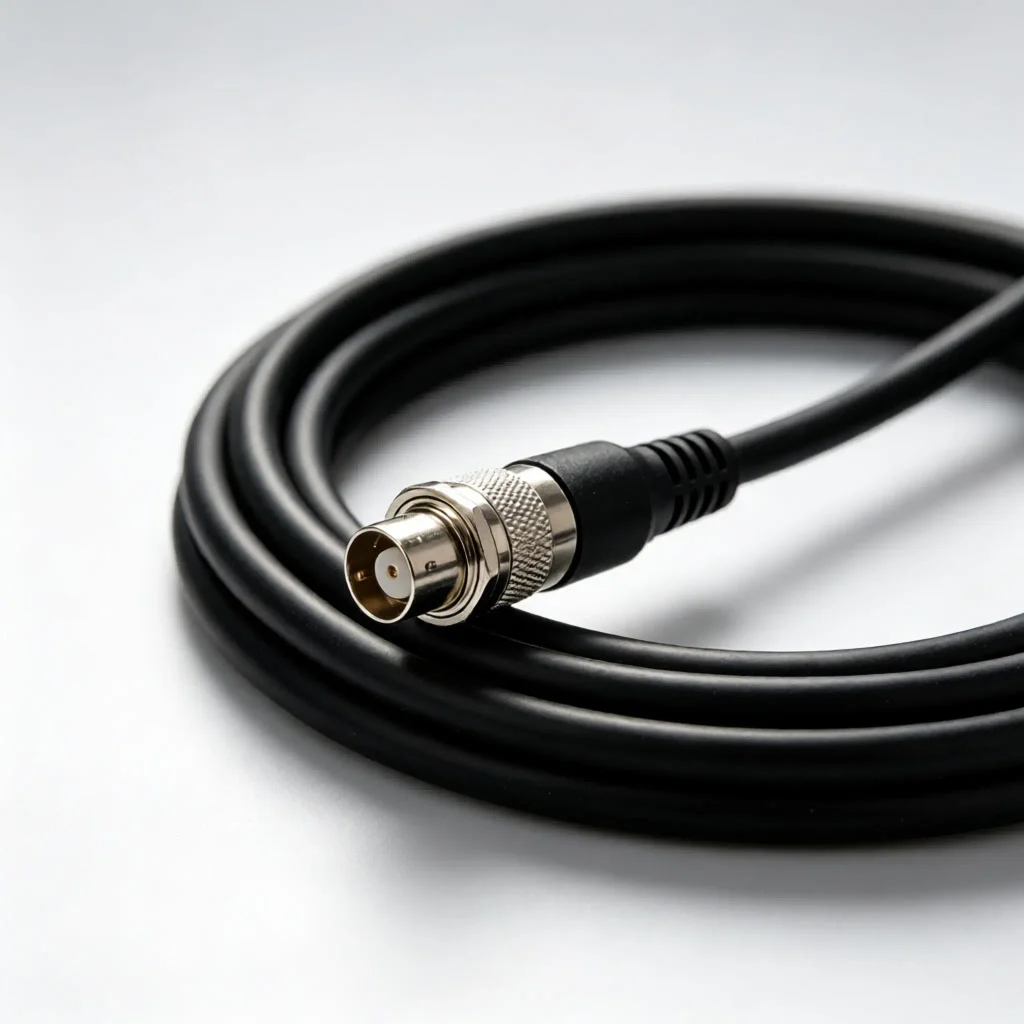
RF coaxial cable is a type of cable specifically designed for the transmission of radio frequency signals. Through optimised structural design and material selection, it effectively reduces signal loss and suppresses external interference. It is widely used in fields such as wireless communications, broadcasting and television, data transmission, satellite communications, and test and measurement equipment.
Basic Structure of RF Coaxial Cable
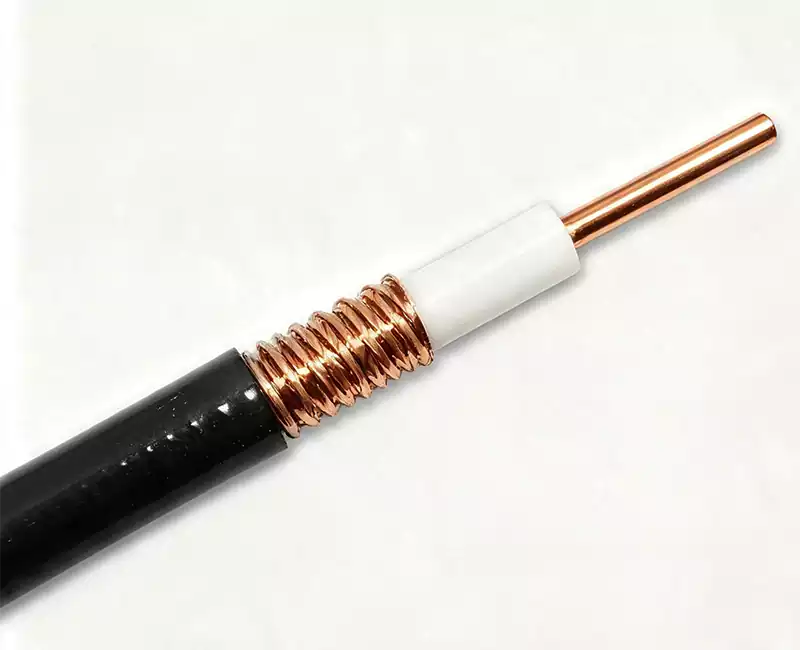
1.Inner Conductor
Typically made of copper or silver-plated copper, its primary function is to transmit RF signals. Structurally, it is classified into two types: single solid conductors and multi-strand twisted conductors.
2.Insulation Layer
Enveloping the inner conductor, common materials include polyethylene (PE), polytetrafluoroethylene (PTFE) and foamed media. Its primary function is to provide electrical insulation between the inner and outer conductors, whilst also serving as structural support.
3.Outer Conductor
Primarily takes the form of a copper braided mesh or aluminium foil; in some applications, a solid metal tube structure is used. Its core function is to shield against external electromagnetic interference, ensuring the stability and integrity of internal signal transmission.
4.Outer Sheath
As the outermost protective layer of the cable, materials such as polyvinyl chloride (PVC), polyethylene (PE) or highly weather-resistant materials are commonly selected. This effectively resists external environmental influences such as moisture, abrasion and chemical corrosion, thereby protecting the internal structure.
Working Principle of RF Coaxial Cables
TEM Wave Propagation Mode
Under ideal conditions, the signal propagates as a transverse electromagnetic wave (TEM wave) within the dielectric between the inner and outer conductors. Both the electric and magnetic fields are perpendicular to the direction of propagation. There is no cutoff frequency, allowing operation from DC to the millimetre wave band.
Electromagnetic Field Confinement
As the inner and outer conductors are concentric and the outer conductor is earthed, the electromagnetic field is completely confined within the dielectric layer, resulting in virtually no outward radiation and strong immunity to external interference.
Characteristic Impedance Matching
The characteristic impedance of the cable (commonly 50Ω or 75Ω) is determined by the ratio of the inner to outer conductor radii and the dielectric constant of the dielectric.
50Ω: Widely used in radio communications, radar and test equipment (balancing power and loss).
75Ω: Primarily used in broadcasting, television, CATV and video surveillance (optimising voltage transmission and minimising loss).
If there is an impedance mismatch in the system, such as at connectors or loads, signal reflections will occur, forming standing waves, which lead to power loss and distortion .
Advantages of high-frequency signal transmission
Compared to standard twin-wire cables, the coaxial structure avoids the issue of radiating energy like an antenna at high frequencies. The outer conductor shield effectively suppresseselectromagnetic interference (EMI) andsignal attenuation.
Classification of RF Coaxial Cables
RF coaxial cables can be divided into various types and specifications based on their different characteristics and application requirements. The following are several common classifications of RF coaxial cables:
RG-6
RG-6 is a commonly used RF coaxial cable, primarily employed in fields such as cable television, satellite television and broadcasting. It features low transmission loss and good shielding performance, making it suitable for long-distance high-frequency signal transmission.
RG-58
RG-58 is a compact RF coaxial cable, frequently used in computer networks and wireless communication equipment. It is characterised by high flexibility and ease of installation, making it suitable for short-distance high-frequency signal transmission.
RG-213
RG-213 is a larger-gauge RF coaxial cable, primarily used in amateur radio and communication systems. It features low transmission loss and excellent interference resistance, making it suitable for long-distance, high-power signal transmission.
In addition to the common classifications mentioned above, there are other types of RF coaxial cables, such as RG-59, RG-174, LMR-200, each with its own specific application scenarios and technical requirements.
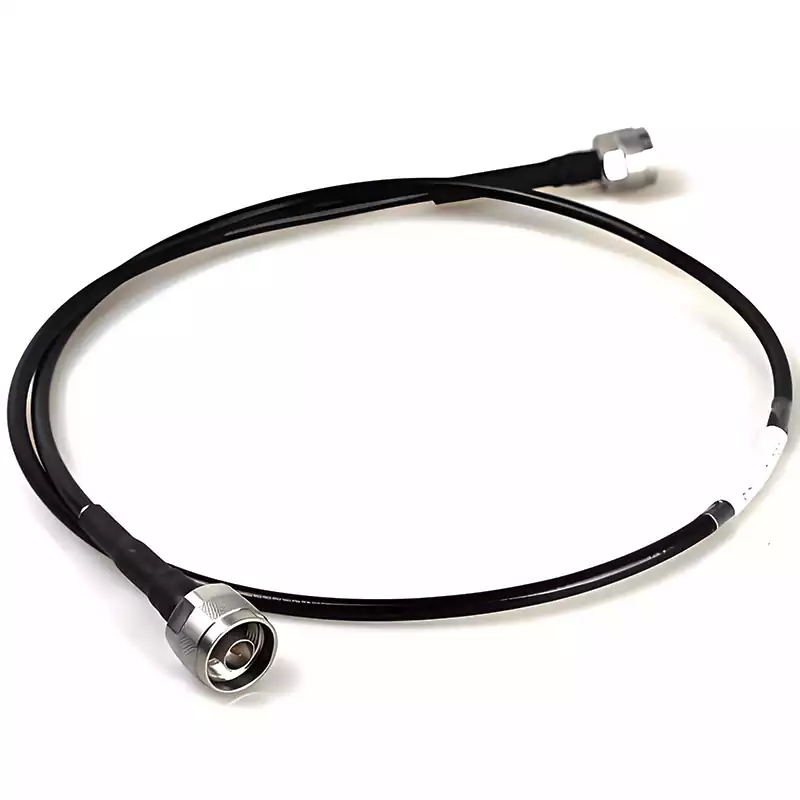
Key Performance Indicators of RF Coaxial Cables
1.Characteristic Impedance
The standard characteristic impedances for RF cables are typically 50Ω and 75Ω. 50Ω achieves an optimal balance between power capacity and signal attenuation, making it the universal standard for RF and microwave systems; 75Ω prioritises minimal signal attenuation and is primarily used in broadcasting, television, and cable communications.
Impedance mismatch directly causes signal reflection, leading to an increase in the standing wave ratio and a significant reduction in transmission efficiency. Therefore, the cable, connectors and system ports must maintain consistent impedance; this is a fundamental prerequisite for achieving maximum power transmission and minimum signal loss.
2.Attenuation (Insertion Loss)
Attenuation is a key indicator of the extent of electromagnetic energy loss during transmission along a cable; this loss primarily stems from three sources: dielectric loss, conductor loss and radiation loss. The greater the insertion loss of a cable, the more severe the signal attenuation and the lower the transmission efficiency.
Loss characteristics are strongly correlated with multiple parameters: they increase sharply with rising frequency, are proportional to cable length, and are directly influenced by the materials of the inner and outer conductors and the type of insulating dielectric.
3.Voltage Standing Wave Ratio (VSWR)
Discontinuities in the impedance of RF cables cause signal reflection, resulting in a loss of incident wave energy. Maximising power transmission and minimising reflection within a system depends on the impedance matching between the cable and other components.
The VSWR directly characterises the degree of signal reflection: the lower the value, the better the consistency of the cable’s impedance and the higher the signal transmission efficiency. Its equivalent parameters are the reflection coefficient and return loss. Taking industry standards as an example, the VSWR of high-quality microwave cable assemblies is typically controlled between 1.1 and 1.3, corresponding to return loss of 26.4–17.7 dB, with incident power transmission efficiency reaching 99.8%–98.3%. To put it simply: when 100 W of power is input, if VSWR = 1.33, the output power is approximately 98 W, with only 2 W of power being reflected.
4.Phase Stability
Cable bending directly causes phase shifts; the smaller the bending radius, the greater the bending angle, and the more bends there are, the more significant the phase shift becomes. Bend-phase stability is a core metric for assessing a cable’s ability to maintain phase under bending conditions; bending behaviour during use directly affects the insertion phase.
The pattern of phase change is clear: reducing the bending radius, increasing the bending angle, or increasing the number of bends will all exacerbate phase shift; furthermore, the amount of phase change is largely linearly correlated with frequency.
Main Application Areas of RF Coaxial Cables
Broadcast and Television Signal Transmission
As the mainstream medium for television signal transmission, it is widely used for signal connection and transmission between television antennas and receivers, set-top boxes, and televisions.
Wireless Communication Systems
Used in mobile communication base stations, indoor distribution systems, wireless equipment, etc., to achieve high-frequency signal transmission between base stations and antennas, as well as RF modules.
Computer Networks and Data Communications
Used for signal interconnection between network devices, including signal transmission in scenarios such as routers, switches, modems and broadband access.
Radar and Satellite Communications
Suitable for radar systems, satellite ground stations, and airborne/shipborne communication equipment, ensuring the stable transmission of high-frequency, high-power RF signals.
Testing, Measurement and Instrumentation
Widely used in laboratories, production testing and RF testing, for signal transmission and calibration in equipment such as spectrum analysers, signal generators and network analysers.
With its outstanding shielding and transmission performance, RF coaxial cable provides a solid foundation for a wide range of high-frequency applications, from 5G base stations to satellite communications. As technology evolves towards higher frequency bands, it will continue to serve as a key physical layer cornerstone, connecting the future of the Internet of Everything.