What is an rf cable?Radio frequency cables(RF cables) are cables designed to transmit electromagnetic energy within the radio frequency range. They are indispensable components in various radio communication systems and electronic equipment, and are widely used in wireless communications, broadcasting, television, radar, navigation, computers and instrumentation.
Basic Structure
Radio frequency cables, also known as coaxial cables, consist of an inner conductor and an outer conductor arranged coaxially, supported by a dielectric material.
Inner Conductor
Material: Metals with good electrical conductivity, such as copper and aluminium, are typically used. Copper, with its high electrical conductivity and good mechanical properties, is the most widely used material for inner conductors; aluminium, being relatively lower in cost, is used in applications where performance requirements are not particularly stringent and cost is a priority.
Shape: Common shapes include solid cylindrical and stranded types. Solid cylindrical inner conductors are simple to manufacture and cost-effective, making them suitable for RF signal transmission in the medium and low frequency bands; stranded inner conductors are formed by twisting multiple fine metal wires together, offering superior flexibility and bending performance, and are commonly used in applications requiring frequent bending, such as connection cables for mobile devices.
Insulating Media
Materials: Common insulating media include polyethylene (PE), polytetrafluoroethylene (PTFE) and foamed polyethylene. Polyethylene offers good electrical and processing properties at a low cost, making it widely used in general-purpose RF cables; polytetrafluoroethylene possesses excellent resistance to high temperatures and chemical corrosion, making it suitable for RF signal transmission in high-temperature and harsh environments; Foamed polyethylene is produced by adding a foaming agent to polyethylene; it has a low dielectric constant and low dielectric loss, effectively reducing signal attenuation during transmission, and is commonly used in high-frequency and ultra-high-frequency RF cables.
Structure: The insulating medium may be solid, air-insulated or semi-air-insulated. Solid insulating medium structures are simple and easy to manufacture; air-insulated structures feature a specific air gap between the inner and outer conductors; as air has a low dielectric constant, this further reduces signal attenuation, though the manufacturing process is relatively complex; semi-air-insulated structures lie between solid and air-insulated types, achieved by incorporating air voids within the insulating medium.
Outer Conductor
Material: Generally made of metallic materials such as copper or aluminium, similar to the inner conductor material, but with greater emphasis on shielding performance and mechanical strength.
Structure: Common structures include braided, tubular and corrugated types. Braided outer conductors are woven from metal wires, offering good flexibility and shielding performance, and are suitable for applications requiring frequent bending; tubular outer conductors consist of a solid metal tube, offering excellent shielding performance but poor flexibility, and are commonly used in fixed installations for RF cables; corrugated tubular outer conductors feature a metal tube with corrugations, providing a degree of flexibility whilst maintaining good shielding performance, and are suitable for applications with high requirements for both flexibility and shielding performance.
Sheath
Materials: Common sheath materials include polyvinyl chloride (PVC), polyethylene (PE) and polyurethane (PU). Polyvinyl chloride (PVC) offers good abrasion resistance, corrosion resistance and flame retardancy, and is relatively low-cost, making it widely used in general-purpose RF cables; polyethylene (PE) offers good flexibility and weather resistance, making it suitable for outdoor RF cables; polyurethane (PU) offers excellent abrasion resistance, oil resistance and chemical corrosion resistance, and is often used in RF cables for harsh environments.
Function: The sheath primarily serves to protect the internal structure of the cable, preventing mechanical damage, chemical corrosion and the effects of environmental factors, whilst also enhancing the cable’s visual quality and tactile feel.
In radio communications and radio and television RF transmission, RF cables are essential equipment. If selected inappropriately, this will not only result in waste and increased investment costs, but may also cause system instability during operation, leading to faults and equipment damage.
The characteristics of RF cables include electrical and mechanical properties. Electrical properties encompass characteristic impedance, transmission loss and its frequency response, temperature characteristics, shielding performance, rated power, and maximum voltage withstand. Mechanical properties include minimum bending radius, weight per unit length, maximum allowable tensile force, as well as the cable’s ageing characteristics and consistency.
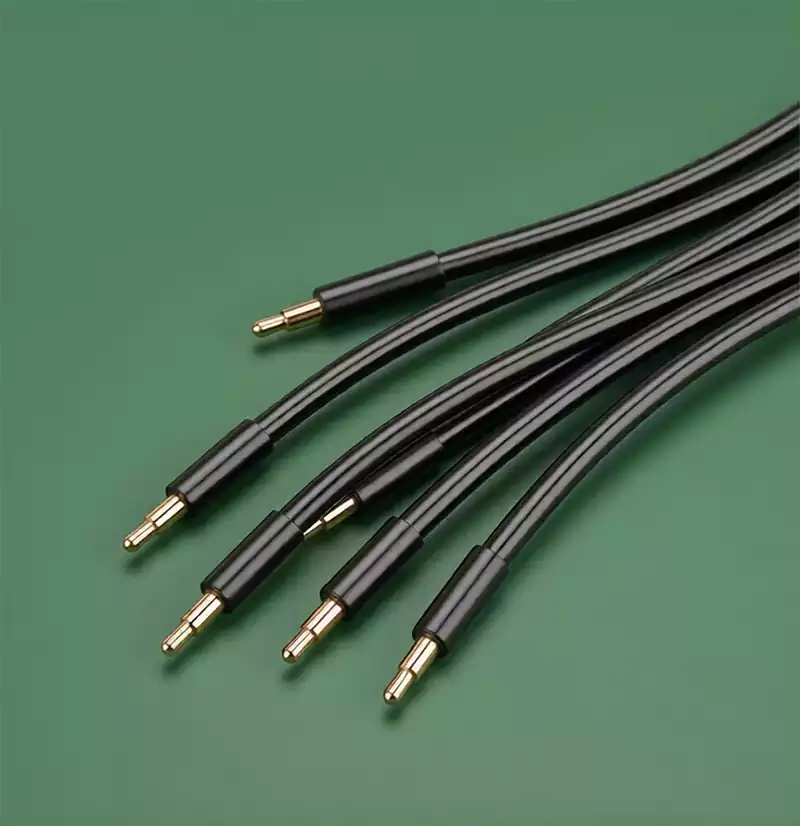
RF Cables Types
Classification by Structure
Coaxial RF Cables
Coaxial RF cables are the most widely used type of structure. Their inner and outer conductors are arranged concentrically; this structure confines the propagation of electromagnetic energy to the dielectric between the inner and outer conductors. Consequently, coaxial RF cables offer numerous significant advantages, such as low signal attenuation, excellent shielding performance, a wide operating frequency range and stable performance. They are typically used to transmit RF energy at frequencies ranging from 500 kHz to 18 GHz.
Common types of RF coaxial cables include 50Ω and 75Ω variants. Among these, RF coaxial cables with a characteristic impedance of 75Ω are frequently used in CATV networks and are therefore also known as CATV cables. The transmission bandwidth of this type of cable can reach up to 1 GHz, although the commonly used transmission bandwidth for CATV cables is 750 MHz.
Symmetrical RF Cables
The electromagnetic field within the circuit of a symmetrical RF cable is open. Under high-frequency conditions, it radiates electromagnetic energy outward, which not only increases signal attenuation but also impairs shielding performance. Furthermore, atmospheric conditions can also affect their performance. Due to these factors, symmetrical RF cables are relatively less common in practical applications and are primarily suitable for low-frequency or symmetrically fed scenarios.
Helical RF Cables
In coaxial or symmetrical cables, the conductor is sometimes formed into a helical coil. This configuration increases the cable’s inductance, thereby altering its characteristic impedance and delaying the propagation of electromagnetic energy. Cables designed primarily to increase characteristic impedance are known as high-impedance cables, whilst those intended to delay electromagnetic energy propagation are termed delay cables. If the winding density of the helical coil varies along its length, variable-impedance cables can also be produced.
Classification by Insulation Type
Solid-insulated cables
In this type of cable, the space between the inner and outer conductors is completely filled with a solid high-frequency dielectric. Most flexible coaxial RF cables employ this insulation type.
Air-insulated cables
In air-insulated cables, apart from a portion of solid dielectric used to support the inner and outer conductors, the majority of the space is filled with air. A key structural feature is that there is no dielectric layer between the conductors. Air-insulated cables exhibit extremely low signal attenuation and are a commonly used structural type in ultra-high-frequency applications.
Semi-air-insulated cables
The insulation structure of semi-air-insulated cables lies between solid-insulated and air-insulated types, consisting of a combination of air and solid dielectric. However, a solid dielectric layer is required to pass from one conductor to another.
Classification by Insulation Material
RF cables can be classified by insulation material into plastic-insulated cables, rubber-insulated cables and inorganic mineral-insulated cables.
Classification by Flexibility
Depending on their flexibility, RF cables can be classified into flexible cables, flat flexible cables and rigid cables, amongst others.
Classification by Transmission Power
RF cables can be classified by transmission power into low-power cables (below 0.5 kW), medium-power cables (0.5–5 kW) and high-power cables (above 5 kW).
Classification by Product Application Characteristics
Based on product application characteristics, RF cables can be classified into low-attenuation cables, low-noise cables, micro-miniature cables and high-phase-stability cables, amongst others.
RF Cable Materials
Copper
Copper is the most commonly used conductor material in RF cables. It offers excellent electrical conductivity and ductility, ensuring efficient signal transmission. Furthermore, copper is highly corrosion-resistant and remains stable in a variety of environments. However, copper is relatively expensive and heavy, so it may not be the optimal choice for applications with strict weight requirements.
Aluminium
As a lightweight metal, aluminium is also widely used in RF cables. Compared to copper, aluminium has a lower density, which reduces the weight of the cable, facilitating installation and transport. Furthermore, aluminium is relatively inexpensive, helping to lower the overall project cost. However, aluminium’s electrical conductivity is slightly inferior to that of copper, and it may perform poorly in certain corrosive environments.
Silver
Silver is one of the most conductive metals and is therefore used in certain high-performance RF cables. Silver cables provide excellent signal transmission and minimise signal loss. However, silver is expensive and is susceptible to oxidation and corrosion, requiring special protective measures.
Alloys
To combine the advantages of different metals, alloys are also used in RF cables. For example, copper-aluminium alloys combine the excellent conductivity of copper with the lightweight properties of aluminium. Alloy cables can be customised to meet specific performance requirements. However, the manufacturing costs of alloy cables are typically higher, and they may exhibit instability in certain extreme environments.
Applications of RF Cables:
Communication Systems: RF cables are widely used in wireless communication systems, such as mobile communication base stations, microwave links and satellite communication systems, to transmit RF signals and connect various devices.
Broadcasting and Television: In the broadcasting and television sector, RF cables are used to transmit broadcast signals and connect equipment such as antennas, modulators and demodulators, ensuring stable signal transmission.
Radar systems: Radar systems require the transmission and reception of high-frequency RF signals; RF cables serve to connect antennas with radar transmitters, receivers and other equipment.
Measuring instruments: In scientific experiments, engineering surveys and other fields, RF cables are used to connect test equipment, signal generators, spectrum analysers and other instruments for the testing and analysis of RF signals.
Aerospace Sector: In the aviation and aerospace sectors, RF cables are used to connect aircraft radar, navigation systems, and communication equipment, ensuring the transmission and communication quality of RF signals.

Functions of RF Cables
The primary function of RF cables is to effectively transmit high-frequency electromagnetic signals. Their core objective is to minimise signal loss and interference between the signal source and the receiving equipment whilst maintaining signal integrity. Specifically, this includes:
Transmission of RF Signals: Transmitting RF signals from the transmitter to the receiver or other equipment.
Shielding Against Electromagnetic Interference: RF cables typically employ a coaxial structure, with the inner conductor and outer conductor providing effective shielding to prevent external electromagnetic interference from affecting signal quality.
Resistance to environmental factors: Designed with properties such as corrosion resistance, temperature resistance and water resistance, ensuring stable signal transmission in complex environments.
Maintaining impedance matching: By precisely controlling the cable’s impedance (typically 50 ohms or 75 ohms), signal reflections are reduced and transmission efficiency is enhanced.
With their diverse structures and suitable materials, RF cables are widely used across numerous sectors. They will continue to be optimised in the future, providing stable support for the development of various industries.