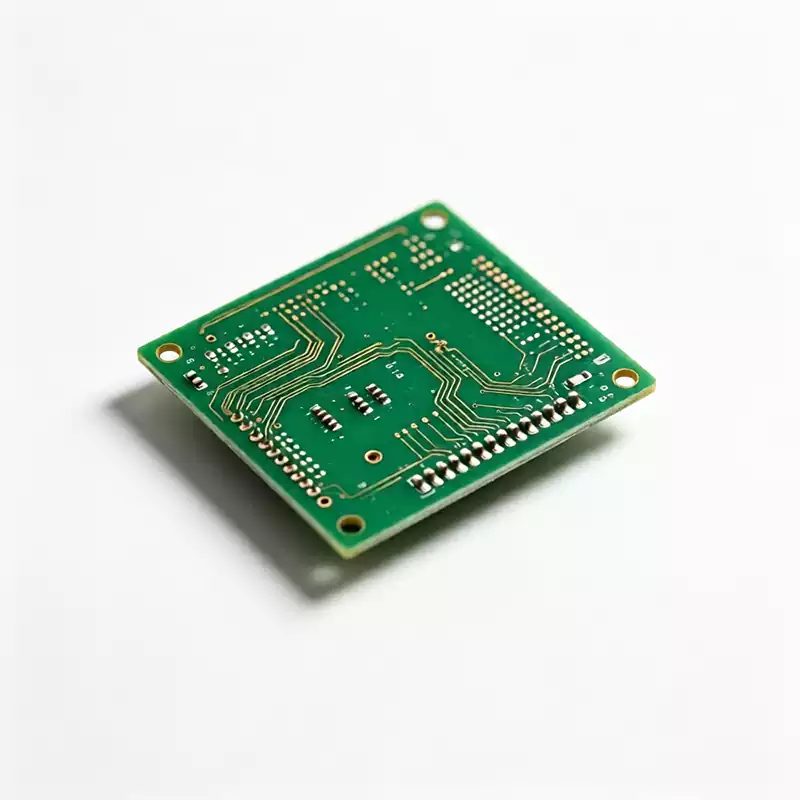
Automotive PCB standards are not a single document you can order and be done with. They are a stack, and each one governs a different layer of the problem: the bare board, the components soldered to it, the process that built it, and the vehicle environment it has to survive. Choose the wrong set and you either pay 30% more than your application demands, or you sail into an audit you never saw coming. This guide maps the stack and tells you which parts actually apply to your project.
Six frameworks cover most automotive PCB programs. Read the table first, then the details.
| Standard | What it governs | What it binds |
|---|---|---|
| ISO 26262 | Functional safety of vehicle E/E systems | Safety-related functions, not the board directly |
| IPC-6012DA | Qualification and performance of rigid PCBs | The board itself |
| AEC-Q100 / Q101 / Q200 | Stress qualification of components | Everything on the BOM |
| IATF 16949 | Quality management process | The entire supply chain |
| ISO 16750 | Environmental loads and testing | The vehicle installation |
| IPC-A-610 Class 3 | Assembly workmanship acceptance | The finished assembly |
A common mistake is treating these as interchangeable “quality levels.” They are not. A automotive PCB can be perfectly IPC-6012DA compliant and still fail ISO 26262, because one is about the pcb board and the other is about the system the board lives in.
ISO 26262: the one everyone misunderstands
ISO 26262 is a functional safety standard for road-vehicle electrical and electronic systems. It classifies risk into Automotive Safety Integrity Levels, ASIL A through ASIL D, and braking, steering, and ADAS functions typically land at ASIL B or D.
Here is the part that trips people up: ISO 26262 does not certify PCB boards. There is no such thing as an “ISO 26262 certified board.” The standard operates at the system level. The system designer assigns an ASIL to each function, and that requirement flows down to the hardware, including the automotive PCB. The board inherits safety goals, it does not carry a certificate.
What that inheritance means in practice is design content, not paperwork. A circuit board supporting an ASIL B or D function has to support fault detection, fault tolerance, and redundancy. Diagnostics have to be designed in so a single-point failure cannot silently take out a safety function. That requirement shapes the layout, the component selection, and the test coverage long before anyone talks about copper weights.
For infotainment and comfort electronics, ISO 26262 is usually out of scope entirely. For anything touching braking, steering, or automated driving, it is the first standard in the stack, not the last.
IPC-6012DA: what it actually specifies
IPC-6012DA is the automotive application section of the IPC-6012 rigid PCB qualification family. It sets acceptance criteria for the board itself: base materials, conductive pattern dimensions, surface finishes, and the mechanical integrity of holes and plating.
The baseline is IPC-6012 Class 3, the high-reliability acceptance class. The automotive enhancements tighten it further. The numbers that matter in practice:
| Parameter | Class 2 baseline | Automotive (Class 3 + DA) |
|---|---|---|
| Copper peel strength | ~1.0 N/mm | 1.4 N/mm minimum |
| Layer-to-layer registration | Relaxed | 75 μm maximum |
| Plated hole fill | Functional minimum | 75% minimum |
| Electrical testing | Sampling | 100% of boards |
| Thermal shock | Standard profile | -55°C to +125°C cycling |
Two of these deserve comment. Peel strength matters because automotive pcb boards live through thermal cycling that pries copper off the substrate, and 1.4 N/mm is where that failure mode gets contained. Layer registration matters because a 10-layer board with 75 μm of drift is a board where your controlled impedance is fiction.
The CAF requirement is the other automotive-specific item. Conductive anodic filament growth is a moisture-driven failure that shorts adjacent features through the substrate, and automotive programs test for it directly, commonly with 1000 hours at 85°C and 85% relative humidity.
None of this is free. The combination of Class 3 acceptance and automotive enhancements typically adds 20% to 40% to board cost through materials, process control, and inspection intensity. That premium is the price of the failure modes you are not going to have.
AEC-Q100, Q101, and Q200: components, not boards
The AEC-Q series qualifies components, not boards. It is the component-level gate that every automotive BOM has to pass before the board is even designed.
| Standard | Covers | Typical contents |
|---|---|---|
| AEC-Q100 | Integrated circuits | Thermal cycling, high-temperature operating life, ESD, vibration, shock |
| AEC-Q101 | Discrete semiconductors | Equivalent stress suite scaled to the part class |
| AEC-Q200 | Passive components | Resistors, capacitors, inductors under automotive stress |
The reliability gap is the point. Consumer and industrial components are specified at failure rates measured in PPM. Automotive grade demands PPB. That is three orders of magnitude, and it is why “the same footprint” is never the same part.
For automotive PCB programs, the practical rule is simple: every component on the BOM has to carry the appropriate Q-number, and qualification has to be verified per part number, not inferred from a family or a similar-looking model. BOM review in automotive programs is a line-item audit for exactly this reason.
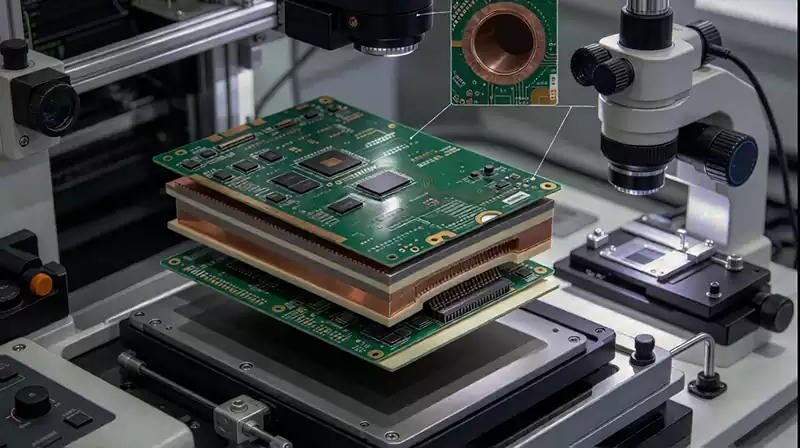
IATF 16949: the entry ticket
IATF 16949 is the quality management standard for automotive supply chains. For a PCB fabricator or assembler, it is not a marketing badge. It is the ticket that gets you into the supply chain at all.
The standard’s core logic is prevention over detection: do not accept defects, do not create them, do not pass them on. That sounds like a slogan until you look at the five tools it mandates:
- APQP (Advanced Product Quality Planning) structures the whole program from design intent through production
- PPAP (Production Part Approval Process) is the evidence package that proves your process can build the part repeatably
- FMEA forces failure-mode analysis before production, not after a field return
- SPC (Statistical Process Control) keeps process parameters inside proven capability limits
- MSA (Measurement System Analysis) validates that your inspection equipment can actually see what you claim it sees
The FMEA requirement is where automotive and consumer practice separate. In a consumer line, if AOI catches a defect, the system is working. In an automotive line, PFMEA assumes the defect will happen and asks what else contains it. AOI has known blind spots on QFN bottom terminations, so automotive programs add 3D X-ray or cross-section analysis behind it. Solder paste volume drifts, so SPC watches the trend and stops the line when capability drops below threshold, commonly Cpk 1.33 as a floor and 1.67 for safety-critical parameters.
Traceability is the other IATF hallmark. Consumer boards trace to a batch. Automotive boards trace to the individual unit, with a unique ID that links the IC lot, the placement machine, the reflow profile, and every inspection result. When a failure happens two years later, the recall scope narrows from “that batch” to “those boards,” and that difference is measured in seven figures.
ISO 16750: the environment the automotive PCB board has to survive
ISO 16750 defines the environmental loads a vehicle imposes on electronics, by installation position. It is the reason automotive material selection looks nothing like consumer selection.
The headline numbers: continuous operation from -40°C to +125°C, with engine-bay positions reaching 150°C. Thermal cycling counts run into the thousands of cycles. Vibration profiles span roughly 5 to 2000 Hz. Design life is commonly specified at 15 years or 320,000 kilometers, whichever comes first.
On the EMC side, CISPR 25 Class 5 sets radiated emission limits as low as 20 dBμV/m in the 30 to 1000 MHz range, and ISO 11452 defines bulk current injection immunity testing from 1 to 400 MHz. For L3 domain controllers and 77 GHz radar boards, these are not paperwork requirements. They are what separates a board that works in a moving EMI environment from one that intermittently does not.
Which set applies to your automotive PCB project
With the stack mapped, the selection becomes a function of what your board does.
Infotainment and comfort systems. IPC-6012DA and IATF 16949 are the baseline. AEC-Q200 on passives is typical. ISO 26262 is usually out of scope. High-Tg FR-4 handles the thermal load. This is the least expensive automotive tier, and it is still materially more expensive than consumer.
Body and chassis control. Add AEC-Q100 and Q101 to the active components. IPC-A-610 Class 3 acceptance on the assembly. Registration and hole fill control matter more as layer counts climb.
Safety, braking, and ADAS. ISO 26262 enters with ASIL B or D requirements, and the board design has to support the diagnostics, redundancy, and fail-safe behavior the safety concept demands. Controlled impedance tightens, commonly to ±5%, and high-speed interfaces push signal integrity requirements into the 25 Gbps class. This is where automotive PCB standards stop being a cost line and become a design constraint.
Powertrain and EV power electronics. The harshest ISO 16750 profiles apply, with 150°C zones, thick copper for current capacity, and metal-core or ceramic constructions where heat flux demands them.
One trend is raising the floor across all tiers. China’s first L3 conditional-driving approvals landed in late 2025, with pilot programs expanding across more than twenty cities through 2026, and L3 designs are estimated to consume roughly 40% more PCB board area than L2 equivalents. Standards that were reserved for premium programs are quietly becoming the mainstream spec.
What to ask your automotive PCB fabricator about standards
If you are sourcing an automotive PCB, these questions separate real automotive suppliers from hopeful ones:
Can you build to IPC-6012DA, and what is your documented capability on peel strength, registration, and hole fill? Are you IATF 16949 certified, and can you show a PPAP package from a comparable program? What AEC-Q verification do you require on incoming components, and do you check it per part number? What traceability granularity comes with delivery, and can you demonstrate a unit-level lookup? Which ISO 16750 profiles have your constructions actually passed, and can you see the test reports?
A supplier who answers with documents has shipped safety-related electronics before. A supplier who answers with adjectives is planning to learn on your program, and the recall statistics suggest how expensive that education gets.
The short version: match the automotive PCB standards to the application, not to the highest available tier. Pay for Class 3 and ISO 26262 where the function demands them, and refuse to pay for them where it does not. Getting that line right is most of what separates a competitive automotive program from an overpriced one.
Frequently asked questions
Does IPC-6012DA apply to every automotive PCB? It is not a legal mandate everywhere, but it is the de facto qualification standard across automotive supply chains. Any board destined for an OEM program should be built to it, and safety-critical boards need the Class 3 acceptance level underneath it.
Does ISO 26262 certify a automotive PCB? No. ISO 26262 is a system-level functional safety standard. ASIL levels are assigned to vehicle functions by the system designer and flow down to hardware requirements. A board supports an ASIL target; it does not carry an ISO 26262 certificate.
What is the difference between AEC-Q100 and AEC-Q200? AEC-Q100 covers active components, primarily integrated circuits. AEC-Q200 covers passive components such as resistors, capacitors, and inductors. AEC-Q101 sits in between for discrete semiconductors. A complete automotive BOM needs the appropriate qualification on every part.
How much more does automotive pcb Class 3 cost than Class 2? Typically 20% to 40% more, driven by higher-grade materials, tighter process control, and 100% electrical testing instead of sampling. The premium scales with layer count and the strictness of the automotive enhancements applied.