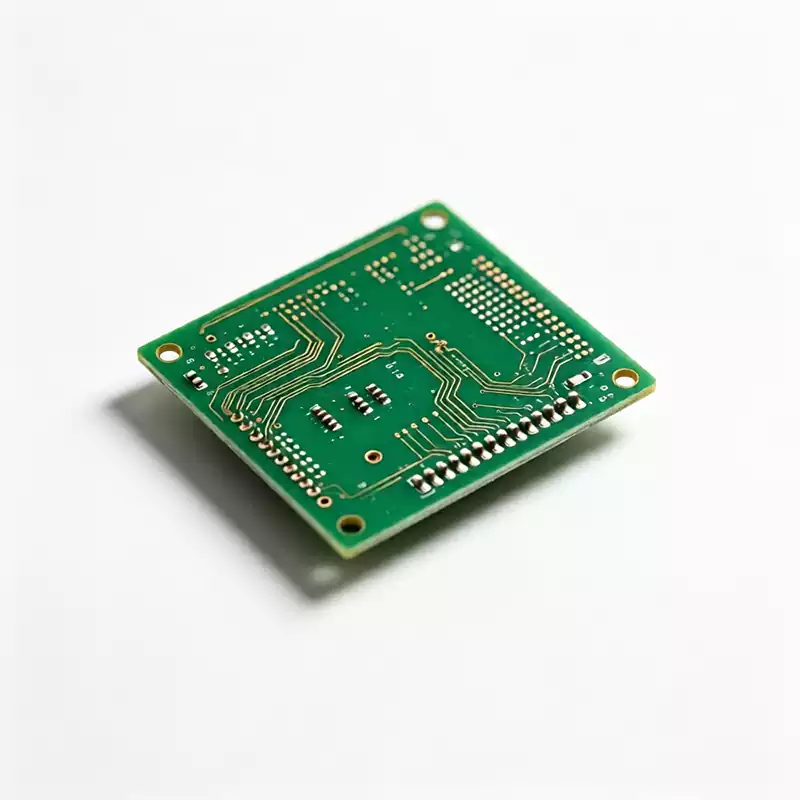
FR-4 PCB material is a glass-reinforced epoxy laminate widely used as the insulating substrate in rigid printed circuit boards. It combines woven glass fiber reinforcement with an epoxy resin system to provide mechanical strength, electrical insulation, dimensional stability, and flame-retardant performance. Copper foil is bonded to the laminate to form copper-clad material, which can then be processed into conductive traces, pads, ground planes, and other circuit features.
The widespread use of FR-4 comes from its balanced performance rather than exceptional performance in any single category. It supports a broad range of electronic designs, from basic control boards and consumer devices to industrial electronics and multilayer PCB assemblies. Its availability across many material grades also gives designers and manufacturers flexibility when balancing electrical requirements, thermal reliability, fabrication constraints, and cost.
However, FR-4 does not describe one exact laminate formulation. Different manufacturers offer grades with different glass transition temperatures, dielectric properties, thermal decomposition characteristics, coefficients of thermal expansion, and moisture resistance. Selecting FR-4 therefore requires more than specifying the material name on a drawing. The actual laminate grade must suit the board’s operating environment, assembly process, electrical requirements, and expected service life.
What Is FR-4 Made Of?
The performance of an FR-4 PCB substrate depends on the interaction between its reinforcement, resin system, and copper layers. Each component contributes different properties to the finished board.
Glass Fiber Reinforcement
Woven glass fabric forms the structural reinforcement within FR-4 laminate. It helps the board maintain its shape during fabrication, component assembly, and operation. The glass reinforcement also contributes to dimensional stability, tensile strength, and resistance to mechanical deformation.
Glass construction affects more than mechanical performance. Different glass styles and resin contents can influence the laminate’s effective dielectric constant and the uniformity of signal propagation. These differences may become important in high-speed digital designs where propagation delay, skew, and controlled impedance require tighter management.
Epoxy Resin System
The epoxy resin binds the glass fibers together, fills the spaces between them, and provides the insulating matrix around conductive features. Its formulation influences thermal behavior, moisture resistance, dielectric loss, adhesion, and the laminate’s response to repeated heating.
Flame-retardant chemistry is another important part of the resin system. Conventional FR-4 formulations and halogen-free alternatives may use different approaches to meet applicable flammability and environmental requirements. A halogen-free designation should not be treated as a guarantee that every other material property remains identical; the specific grade still needs to be evaluated against the design requirements.
Copper Foil
Copper foil is laminated to the dielectric material to create copper-clad laminate. During PCB fabrication, unwanted copper is removed or otherwise patterned to produce the circuit’s conductive network. Copper thickness, foil type, surface treatment, and adhesion to the resin system influence current-carrying capability, etching behavior, and signal integrity.
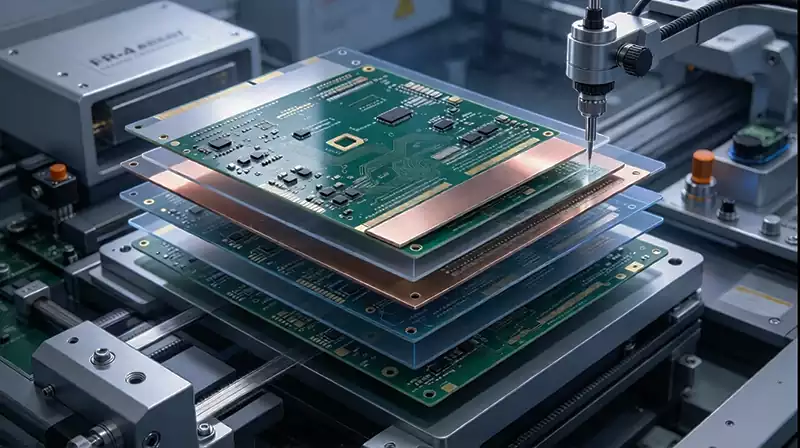
In multilayer PCBs, FR-4 cores and prepreg materials are combined with patterned copper layers during lamination. The selected core thicknesses, prepreg construction, and copper distribution determine the finished stackup and affect impedance, overall thickness, and mechanical reliability.
Key FR-4 PCB Material Properties
When evaluating FR-4, engineers should consider its thermal, electrical, and mechanical properties together. A material that performs adequately in one category may still be unsuitable for a design with demanding assembly conditions, high-speed signals, or repeated thermal cycling.
Glass Transition Temperature (Tg)
The glass transition temperature is the point at which the cured resin changes from a relatively rigid, glassy state to a softer, more rubber-like state. It does not represent a melting point or the temperature at which the material immediately fails. Instead, Tg marks a transition in the resin’s physical behavior, including changes in stiffness and thermal expansion.
Standard, mid-Tg, and high-Tg FR-4 grades are available for different fabrication and reliability requirements. A higher-Tg laminate may be beneficial for multilayer boards exposed to demanding lead-free assembly profiles or repeated thermal excursions. However, Tg alone does not determine whether a material will survive the assembly process. Thermal decomposition temperature, time to delamination, Z-axis expansion, and the manufacturer’s recommended processing limits also matter.
Dielectric Constant (Dk)
The dielectric constant, also called relative permittivity, describes how a dielectric material responds to an electric field. In PCB design, Dk influences signal propagation velocity and the characteristic impedance of transmission lines.
FR-4 does not have one universal Dk value. The measured value depends on the specific laminate, resin content, glass construction, measurement frequency, and test method. Using a generic value during early design calculations may be acceptable for estimation, but production-controlled impedance designs should use data appropriate to the intended material and stackup.
For high-speed interfaces, differences in dielectric properties can affect impedance consistency, timing, and signal integrity. Designers should therefore confirm the laminate’s relevant electrical data with the material supplier and PCB fabricator before finalizing critical routing dimensions.
Dissipation Factor (Df)
The dissipation factor indicates the degree of dielectric energy loss in a material. As an electrical signal propagates through a PCB, part of its energy is dissipated within the dielectric. Higher dielectric loss can contribute to greater insertion loss, particularly as frequency increases and transmission-line lengths become more significant.
Conventional FR-4 is suitable for many general-purpose digital and analog circuits. However, designs involving demanding high-speed channels, long transmission paths, or higher-frequency RF signals may require a lower-loss laminate. The decision should account for the complete channel budget, copper roughness, conductor geometry, frequency, and other sources of loss rather than relying on Df alone.
Coefficient of Thermal Expansion (CTE)
The coefficient of thermal expansion describes how much a material expands or contracts as temperature changes. FR-4 has different expansion behavior along the X, Y, and Z axes because its glass reinforcement and resin matrix are not uniform in every direction.
The Z-axis is particularly important for plated through-holes and vias. During soldering and subsequent thermal cycling, the board expands through its thickness, placing stress on the copper plating inside drilled holes. Excessive expansion, combined with unsuitable material properties or demanding board construction, can increase the risk of via-barrel cracking and other reliability problems.
Material selection should therefore consider Z-axis CTE alongside Tg, thermal decomposition characteristics, board thickness, via aspect ratio, and the number of expected thermal excursions.
Thermal Conductivity
FR-4 is primarily an electrical insulating material, not a highly conductive heat-spreading substrate. Its thermal conductivity is relatively low compared with copper or aluminum, so the laminate itself does not efficiently move heat away from concentrated power sources.
PCB designers commonly manage heat through copper planes, wider copper areas, thermal vias, heat sinks, and suitable enclosure or airflow design. Where power density or thermal constraints exceed what these measures can reasonably address, a metal-core PCB or another specialized substrate may be more appropriate.
Increasing the Tg of an FR-4 laminate does not automatically make it a better thermal conductor. High-Tg materials address aspects of thermal stability and expansion behavior; heat dissipation remains a separate design consideration.
Common Types of FR-4 PCB Material
FR-4 materials are available in several grades and formulations. The appropriate choice depends on the board’s thermal exposure, electrical requirements, environmental constraints, and manufacturing complexity.
| FR-4 Material Category | Key Material Consideration | Typical PCB Design Context |
|---|---|---|
| Standard FR-4 | Balanced cost, electrical insulation, and mechanical performance | General-purpose rigid PCB designs |
| Mid-Tg FR-4 | Higher glass transition temperature than some standard FR-4 grades | PCB designs with more demanding assembly or reliability requirements |
| High-Tg FR-4 | Improved thermal-transition characteristics and potentially better thermal-cycle margin | Multilayer PCBs and applications involving demanding thermal processing |
| Halogen-Free FR-4 | Formulation designed to meet specified halogen restrictions | Products with defined environmental or material compliance requirements |
| Low-Loss FR-4 | Electrical properties optimized for reduced dielectric loss compared with conventional FR-4 | Selected high-speed digital PCB applications |
These categories are not interchangeable specifications, and their properties can overlap. For example, a halogen-free material may also be available in a high-Tg formulation, while low-loss grades may use specialized resin and glass constructions. Engineers should evaluate the manufacturer’s specific datasheet rather than assuming a material’s properties from its category name.
Where Is FR-4 PCB Material Used?
FR-4 supports a broad range of electronic products because it offers a practical combination of electrical insulation, mechanical strength, fabrication compatibility, and cost.
Consumer Electronics
Consumer electronics commonly use FR-4 for control boards, interface circuits, power-management sections, and general digital circuitry. The material is available in different thicknesses and copper configurations, making it adaptable to a wide range of board outlines and component layouts.
For compact devices, the material grade and stackup still need to account for component density, assembly temperatures, mechanical support, and the electrical requirements of high-speed interfaces.
Industrial Control Systems
Industrial control boards often combine digital logic, analog sensing, communications, and power-control circuits. FR-4 can serve as a practical substrate for these applications when the selected grade meets the operating temperature, electrical isolation, and expected service-life requirements.
Equipment exposed to temperature fluctuations, vibration, humidity, or repeated power cycling may require a more careful review of material specifications and PCB construction than a basic room-temperature application.
Multilayer PCBs
FR-4 is widely used in multilayer PCB construction, where multiple copper layers are separated by dielectric material and bonded into a single board. A multilayer stackup can provide dedicated signal layers, ground planes, power planes, and more efficient routing for complex designs.
As layer count, board thickness, and via complexity increase, material selection becomes more closely connected to lamination performance, registration, Z-axis expansion, and plated-via reliability. A suitable FR-4 grade should be chosen together with the stackup and fabrication requirements, not as an isolated purchasing decision.
Power and Embedded Electronics
FR-4 can support many low- and moderate-power electronic designs, provided the board’s current-carrying capability, temperature rise, electrical clearances, and heat-removal strategy are adequately designed. Copper thickness, trace geometry, plane layout, and thermal vias often have a significant influence on the result.
For designs with concentrated heat sources or demanding thermal dissipation requirements, engineers should assess whether a conventional FR-4 construction remains suitable or whether a different substrate and thermal architecture are necessary.
FR-4 vs High-Tg FR-4
Standard FR-4 and high-Tg FR-4 share the same broad glass-reinforced epoxy material family, but they are not necessarily equivalent in thermal behavior or reliability performance.
Standard FR-4 may be sufficient for a straightforward board with moderate thermal exposure and a compatible assembly process. High-Tg FR-4 can provide additional margin for designs involving demanding thermal processing, complex multilayer construction, or repeated thermal excursions. The actual benefit depends on the complete set of material properties, including decomposition temperature and Z-axis expansion.
A higher Tg does not automatically guarantee better signal integrity, greater thermal conductivity, or lower manufacturing cost. Nor does every multilayer PCB require high-Tg material. The selection should be based on the board’s specified requirements and the verified properties of the proposed laminate.
For a more detailed comparison of standard and high-Tg grades, this article should link to the planned companion article, High-Tg FR-4 vs Standard FR-4 for Multilayer PCBs.
When Is FR-4 Not the Best Choice?
Although FR-4 is versatile, some applications place demands on a PCB that conventional glass-reinforced epoxy laminate may not meet efficiently.
High-frequency and RF circuits may require low-loss materials with more tightly controlled dielectric properties to manage insertion loss and impedance. Flexible circuits generally require flexible substrate systems such as polyimide rather than a conventional rigid FR-4 laminate. High-power applications may benefit from metal-core or other thermally engineered substrates when heat must be conducted away from critical components.
The decision is not simply whether FR-4 is good or bad. It is whether the material’s electrical, thermal, mechanical, and manufacturing properties align with the actual application. In some designs, a qualified FR-4 grade is the most economical solution; in others, a specialized material can reduce performance limitations or reliability risks.
How to Choose the Right FR-4 PCB Material
A reliable material-selection process begins with the board’s requirements rather than with a material label.
First, define the operating and assembly temperatures. Identify the expected operating environment, soldering profile, rework conditions, and number of anticipated thermal excursions. Use these requirements to evaluate Tg, decomposition temperature, time to delamination, and CTE.
Second, establish the electrical requirements. For controlled-impedance or high-speed designs, confirm the relevant Dk and Df data, test conditions, frequency range, copper construction, and dielectric thickness. Ask the fabricator to validate the proposed stackup and impedance calculations when tight tolerances are required.
Third, evaluate the board construction. Layer count, finished thickness, drilled-hole dimensions, via aspect ratio, copper distribution, and lamination sequence all affect fabrication and reliability. More complex multilayer designs may justify a material grade with stronger thermal or dimensional-stability characteristics.
Fourth, review environmental and compliance requirements. Confirm any applicable flammability classification, halogen restrictions, industry requirements, moisture exposure, and other product-specific constraints. Do not assume that a generic FR-4 designation confirms every required certification or compliance status.
Finally, confirm availability and manufacturing compatibility. A material may look suitable on paper but introduce avoidable cost, lead-time, or processing challenges if it is not compatible with the intended fabrication route. Confirm the exact laminate grade, acceptable alternatives, and relevant datasheet values with the PCB supplier before releasing the design for production.
What Should You Specify When Ordering an FR-4 PCB?
A material description such as “FR-4” may be insufficient for a design with strict electrical or reliability requirements. A more complete fabrication package should identify the relevant properties and tolerances needed to produce the intended board consistently.
Depending on the application, the specification may include:
- The required FR-4 grade or approved laminate family.
- Tg and other applicable thermal-reliability requirements.
- Required dielectric properties and the relevant measurement conditions for controlled-impedance designs.
- Finished board thickness, copper weights, and dielectric thicknesses.
- Layer count, stackup requirements, and any impedance targets.
- Applicable flammability, environmental, and compliance requirements.
- Restrictions on material substitution where a change could affect electrical performance or reliability.
For controlled-impedance boards, the final material and stackup should be agreed upon with the fabricator before production. If a supplier proposes a substitute, its electrical and thermal characteristics should be reviewed rather than assuming that any material carrying the FR-4 designation will behave identically.
Frequently Asked Questions About FR-4 PCB Material
Is FR-4 the same as fiberglass?
Not exactly. Fiberglass is the reinforcement used within the laminate, while FR-4 combines woven glass fabric with an epoxy resin system and flame-retardant characteristics. The resulting composite provides both mechanical support and electrical insulation for the PCB.
Does every FR-4 PCB have the same Tg?
No. FR-4 covers multiple laminate grades, and their Tg values depend on the specific resin system and material formulation. The exact value should be verified in the manufacturer’s datasheet using the relevant test method.
Is FR-4 suitable for high-speed PCB design?
FR-4 can be suitable for many high-speed digital applications, but the answer depends on the signal frequency, channel length, insertion-loss budget, impedance requirements, and the properties of the selected grade. Designs with more demanding loss or dielectric-consistency requirements may need a low-loss laminate.
Is high-Tg FR-4 always better than standard FR-4?
No. High-Tg FR-4 can be beneficial when thermal processing and reliability requirements justify it, but it is not automatically superior in every electrical, thermal, or cost-related category. The best choice is the grade that meets the board’s verified design and manufacturing requirements.
Does FR-4 dissipate heat well?
Conventional FR-4 has relatively low thermal conductivity. Designers generally rely on copper planes, thermal vias, heat sinks, and system-level cooling to manage heat. A metal-core or specialized thermal substrate may be more appropriate for applications with demanding heat-dissipation requirements.
Can FR-4 be used for multilayer PCBs?
Yes. FR-4 is widely used in multilayer PCB construction. The material grade, core and prepreg combination, stackup, and lamination process should be selected together to satisfy the electrical and mechanical requirements of the finished board.
FR-4 PCB material remains a practical choice for many rigid printed circuit boards because it combines mechanical reinforcement, electrical insulation, flame-retardant performance, and broad manufacturing availability. Its suitability, however, depends on the grade selected and the demands of the application.
Engineers should evaluate thermal behavior, dielectric properties, expansion characteristics, stackup complexity, and compliance requirements before finalizing a material specification. When those factors are considered together, FR-4 material can provide a reliable foundation for a wide range of PCB designs without introducing unnecessary material cost or performance limitations.