RF coaxial cables are core components for high-frequency signal transmission in wireless communications, microwave testing, radar, aerospace, and related fields. The mainstream market offers three categories: flexible, semi-flexible, and semi-rigid. These differ significantly in outer jacket material, internal conductor structure, electrical specifications, and mechanical durability, each suited to entirely different equipment operating conditions and application scenarios.
Basic Structure and Characteristics of the Three Types of RF Coaxial Cables
1.Flexible RF Coaxial Cable
Both the inner and outer structures of flexible cables use lightweight, soft materials. The outer jacket is made of high-elasticity soft plastic, while the internal transmission conductor consists of multiple strands of fine copper wire twisted together. The cable can be bent, twisted, and shaped without any resistance.
Advantages: Extremely small bend radius, low difficulty in routing within confined and complex equipment cavities, flexible and convenient on-site installation, and the lowest per-meter procurement cost among the three types.
Limitations: High-frequency electrical transmission performance is relatively weak, and shielding performance degrades after prolonged repeated bending.
2.Semi-Flexible RF Coaxial Cable
Performance-wise, semi-flexible cables sit between flexible and semi-rigid cables. They are often defined in the industry as “manually shapeable RF cables.” The outer layer uses a metal braid with a certain degree of stiffness. No large-scale processing equipment is required—moderate bending and shaping can be done entirely by hand with basic tools.
Advantages: Comes with inherent mechanical support. Once bent, it holds the preset routing shape. Shielding and signal loss metrics are comprehensively superior to flexible cables.
Limitations: Supports only a limited number of shaping cycles. Long-term stress leads to irreversible deformation, making it unsuitable for scenarios requiring frequent line adjustments.
3.Semi-Rigid RF Coaxial Cable
Visually resembling a sealed metal conduit, semi-rigid cables are extremely rigid with maximum structural stability. The outer layer is a seamless solid metal tube, filled internally with a solid dielectric insulating medium that separates the inner and outer conductors.
Advantages: Top-tier resistance to mechanical deformation and external electromagnetic interference, extremely low RF transmission loss, industry-leading shielding and isolation. Once formed, the cable shape is permanently fixed and will not deform due to vibration or temperature changes.
Limitations: Precision bending must be performed using CNC machines. On-site manual modification is not possible, and upfront procurement and processing costs are relatively high.
Core Underlying Technical Performance Differences
1.Shielding Capability and High-Frequency Signal Integrity
Shielding performance directly determines whether RF signals are affected by external noise. The structural differences among the three cable types lead to distinctly different shielding behaviors:
Semi-rigid cables use a seamless, monolithic metal tube as the outer conductor. At a 50 MHz operating frequency, an aluminum tube wall of just 12.2 micrometers completely blocks electromagnetic wave penetration. Shielding effectiveness can exceed 110 dB, with RF leakage below −120 dB—virtually eliminating all external electromagnetic interference.
Semi-flexible RF coaxial cables use a metal braid as the outer shield. Basic shielding is ≥ −90 dB. By increasing braid coverage to over 80%, performance can approach that of semi-rigid cables.
Flexible RF coaxial cables cannot use a rigid metal tube structure and rely on a composite shield of aluminum foil layered with multiple braid nets. At frequencies above 18 GHz, low-density PTFE dielectric must be used to reduce signal loss caused by the dielectric itself, compensating for the inherent shielding limitations.
2.Phase Stability Under Temperature Fluctuations
Temperature changes alter the cable dielectric and metal conductor dimensions, causing signal phase shifts. The temperature control capability varies significantly:
Semi-rigid cables are filled with solid PTFE insulating dielectric, with a dissipation factor as low as 2×10⁻⁴ at 25 °C. Combined with the very low thermal expansion coefficient of the copper tube, phase fluctuation over the entire operating range can be kept within 500 PPM—making them the first choice for millimeter-wave and phased-array equipment.
Semi-flexible RF coaxial cables incorporate a glass fiber reinforcement layer within the dielectric to buffer thermal expansion and contraction, controlling overall phase fluctuation within an 800 PPM range—balancing performance with processing difficulty.
Flexible RF coaxial cables achieve phase matching through precision-length conductors and uniform-thickness dielectric. Even with frequent bending, signal phase error can be stably controlled within ±2°, making them suitable for test stations where cables are moved repeatedly.
3.Mechanical Service Life and Full-Cycle Cost Comparison
The forming process, service life, and procurement/processing costs of the three cable types show a clear gradient.
Semi-rigid cables require CNC equipment for custom bending, with a per-unit processing cost of ¥50–200. However, their structure resists aging and vibration, delivering up to 20 years of service life with virtually no replacement cost.
Semi-flexible RF coaxial cables support on-site manual shaping at only ¥10–50 per meter, offering lower upfront investment. However, the metal braid layer is prone to permanent deformation under long-term stress, and frequent line adjustments accelerate performance degradation.
Flexible RF coaxial cables use a silver-tape spiral braid process to optimize bend resistance, with up to 500,000 bend cycles—premium models exceeding 2 million. However, the complex materials and craftsmanship drive the per-meter price to ¥200–500, roughly 5 to 10 times that of semi-rigid cables, making them suitable only for high-value scenarios such as high-frequency testing.
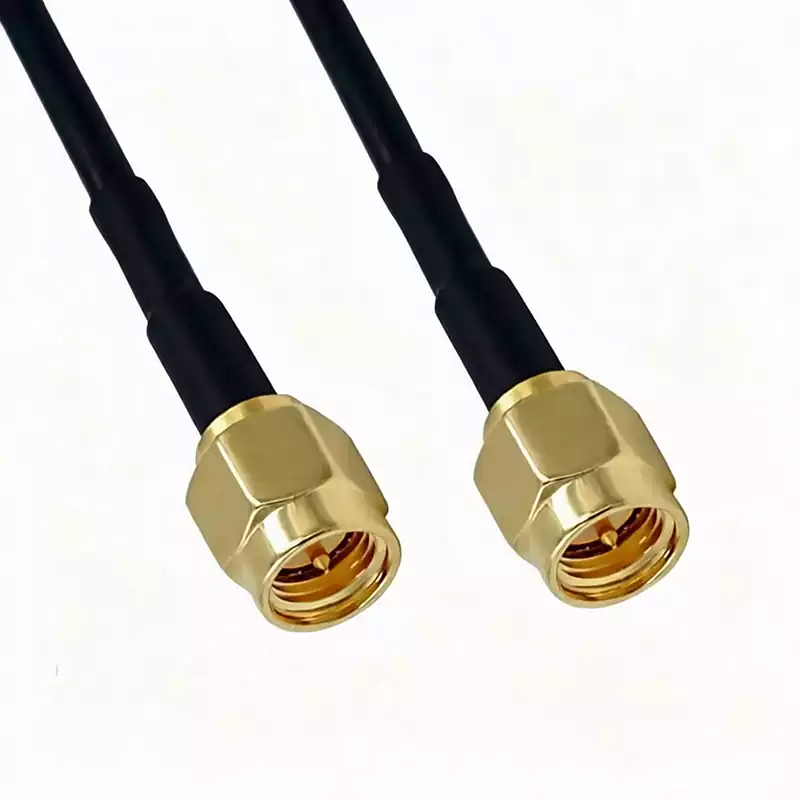
pplication Scenarios for Different RF Coaxial Cables
1.Semi-Rigid RF Coaxial Cable: Stable Transmission Backbone for High-End, High-Frequency Equipment
The combination of a seamless metal tube and solid PTFE dielectric gives semi-rigid cables ultra-high shielding, extremely low passive intermodulation (PIM), and excellent temperature stability. They are used in industries with stringent requirements for signal precision and environmental reliability.
For 5G/6G communication base stations and phased-array radar antennas, these cables cover 3.5 GHz to millimeter-wave bands. Minimal temperature-induced phase drift ensures beamforming accuracy. The 0.047-inch specification with precision connectors supports signals up to 110 GHz, meeting next-generation communication prototype development needs.
For aerospace and deep-space exploration satellites, they withstand an ultra-wide temperature range of −55 °C to +265 °C and offer radiation resistance. Domestic research institutes use SiO₂ dielectric semi-rigid cables for deep-space equipment to handle extreme space conditions.
For semiconductor wafer and chip testing, PIM below −160 dBc minimizes test signal distortion, effectively improving chip yield rates.
2.Semi-Flexible RF Coaxial Cable: Versatile Compromise for Industrial Equipment Interconnection
Semi-flexible cables retain about 80% of the electrical performance of semi-rigid cables while supporting on-site manual bending—balancing installation difficulty with transmission specifications. They are the mainstream choice for internal routing in industrial equipment.
In metallurgy and petrochemical equipment, the LX-50-086 model has an outer diameter of just 2.65 mm with a high/low-temperature-resistant FEP jacket, operating from −40 °C to +150 °C—enabling high-frequency routing even in confined equipment cavities.
For radar and RF lab prototyping, antenna array routing can be manually adjusted at any time during R&D, significantly shortening debug cycles. The X-band radar uses 0.141-inch cables with VSWR stably below 1.2 at 27 GHz.
For indoor distributed signal coverage systems, with a minimum bend radius of just 5× the cable diameter and no need for professional machine tools, they greatly reduce indoor base station installation barriers.
3.Flexible RF Coaxial Cable: Dedicated Cable for Precision Test and Measurement
Multi-strand silver-plated soft conductors, low-density PTFE dielectric, and multi-layer composite shielding support 360° unrestricted bending—ideal for test stations with frequent movement and plug/unplug cycles.
For Vector Network Analyzer (VNA) high-frequency calibration, the Gore CXN3506 flexible cable delivers less than 0.5 dB insertion loss per meter at 40 GHz, ensuring zero deviation in instrument measurements.
For Automated Chip Test Equipment (ATE), premium modified braid-structure cables exceed 2 million bend cycles, with phase error stably within ±1° during repeated motion.
For consumer electronics antenna R&D, the lightweight design at under 0.1 kg per meter adds no burden to robotic test arms, improving production line test efficiency.
Reference Dimensions for Selecting the Right RF Coaxial Cable
Equipment Operating Scenario: For labs and automated chip test equipment, flexible cables are the priority—they suit frequent plug/unplug, movement, and bending. For 5G base stations and indoor distributed communication systems, both semi-flexible and semi-rigid cables work well, with signal long-term stability as the priority. For satellites, aerospace, and deep-space exploration equipment, semi-rigid cables are mandatory to withstand extreme temperatures and radiation. For mobile phones and small consumer electronics R&D production lines, flexible cables offer the best overall value.
RF Electrical Performance Standards: If the project involves millimeter-wave, high-frequency radar, or semiconductor precision testing—where signal purity, phase stability, and shielding are critical—semi-rigid cables are the optimal choice. For ordinary industrial interconnection and indoor signal coverage, semi-flexible cables are sufficient to balance performance needs.
Project Budget and Full Lifecycle Cost: For short-term small debug projects with limited budgets, flexible RF coaxial cables offer more controllable upfront costs.For base stations, aerospace equipment, and other projects requiring stable operation over ten years or more, investing in semi-rigid or semi-flexible cables upfront can significantly reduce the hidden costs of later maintenance and replacement.
On-Site Installation Conditions: When the workspace is confined, no CNC equipment is available, and on-site routing adjustments are needed, flexible or semi-flexible cables are recommended. For factory-standardized batch assembly with fixed routing that requires no later modification, semi-rigid cables should be selected directly.
There is no absolute “best” among flexible, semi-flexible, and semi-rigid RF coaxial cables. Every selection decision must be anchored to the project’s mechanical requirements, RF performance specifications, installation conditions, and budget. Only by understanding the underlying performance differences among the three types and matching them to the actual equipment environment can you avoid common engineering issues such as signal loss, shielding failure, and insufficient bend life.