Flexible RF coaxial cables are pliable transmission lines engineered exclusively for high-frequency signal conveyance, featuring fully compliant internal and external structural materials. Their outermost layer consists of a highly elastic flexible plastic jacket, while the inner conductor is fabricated from stranded fine copper wires, enabling unrestricted 360-degree bending, twisting and shaping without mechanical resistance of any kind.
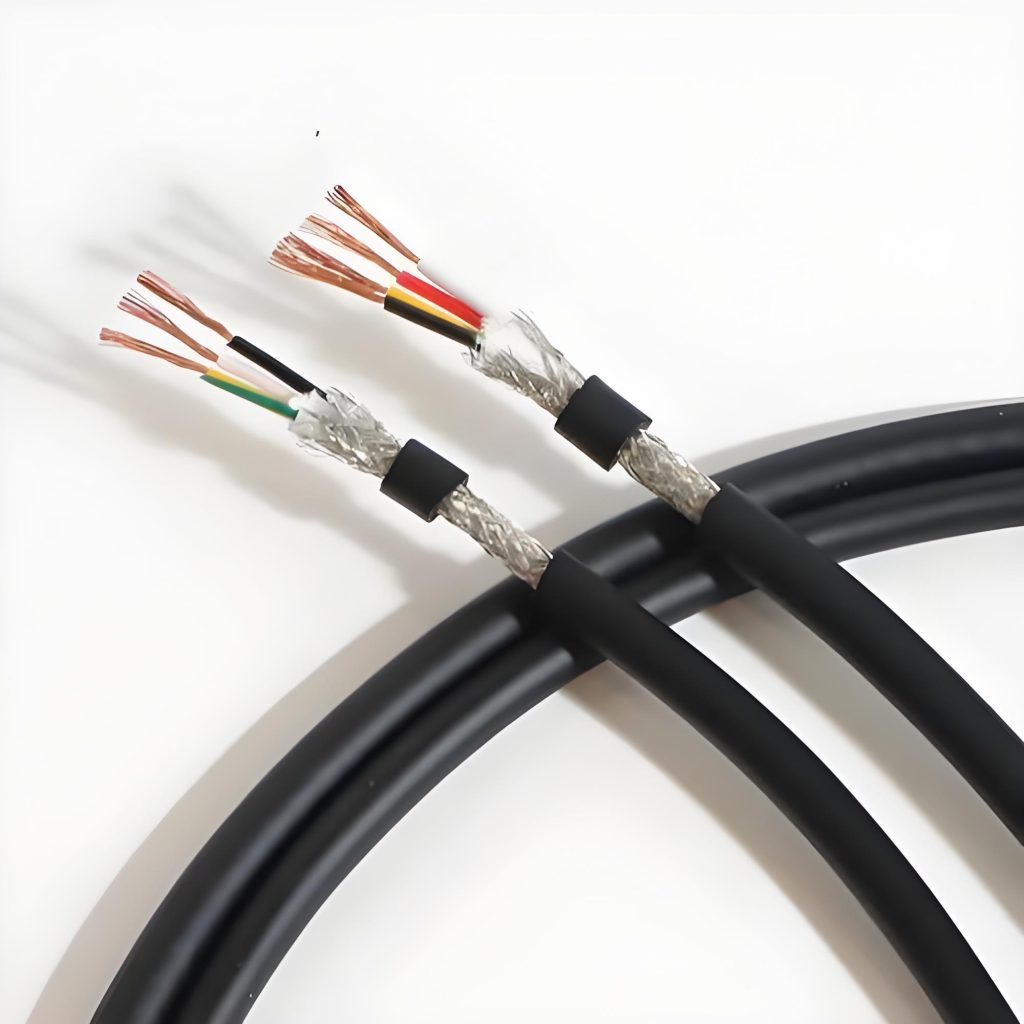
A flexible coaxial cable comprises four fundamental components:inner conductor, dielectric insulation layer, outer conductor and outer jacket. The inner conductor, typically constructed from copper or aluminium, carries electrical signals across the line.Sandwiched between the two conductive layers, the dielectric serves as electrical isolation to eliminate crosstalk between conductors.
The outer conductor, generally implemented as copper braid or aluminium foil, delivers electromagnetic shielding to attenuate external interference, whereas the outer jacket safeguards the entire cable assembly against physical abrasion and harsh ambient conditions. Unlike standard rigid coaxial cables, flexible variants are purpose-built to accommodate continuous flexing and positional movement, sustaining consistent electrical performance even within confined enclosures and dynamically operating equipment.
The operational principle of flexible coaxial cables hinges on guided electromagnetic wave propagation. As signals propagate through the inner conductor, an electric field forms within the dielectric medium; concurrently, the surrounding outer conductor forms a shield barrier that effectively blocks extraneous electromagnetic radiation. These cables boast an expansive frequency response spanning low to high radio frequencies, rendering them viable for an extensive spectrum of industrial and electronic applications.
Key Performance Merits of flexible RF coaxial cables
Superior dynamic flex tolerance delivers a minimum bend radius equivalent to three times the cable outer diameter, perfectly matching the operational demands of robotic manipulators, wearable electronics and other systems undergoing repetitive motion.
Optimised conductor geometry and proprietary dielectric formulations yield ultra-low signal attenuation, maintaining loss figures below 0.2 dB/m across the 0–6 GHz frequency band.
A dual-layer shielding architecture blocks 99% of external electromagnetic interference, ensuring reliable signal integrity within dense, interference-prone electromagnetic environments.
Primary Application Verticals of flexible RF coaxial cables
In medical electronics, flexible RF coaxial cables transmit high-fidelity signals for portable ultrasound scanners, endoscopic imaging systems and other mobile clinical diagnostic hardware.
Within industrial automation infrastructure, flexible RF coaxial cables facilitate signal routing for robotic arm control units, automated guided vehicle (AGV) navigation modules and all equipment requiring dynamically reconfigurable cabling paths.
For broadcast audio and video workflows, flexible RF coaxial cables stabilise high-definition 4K and 8K signal delivery in mobile production trucks and aerial drone cinematography rigs.
Rollout of 5G cellular infrastructure and exponential proliferation of IoT hardware continue to expand the deployment scope of high-performance, bendable RF transmission cabling.
Distinctions Between Flexible, Semi-Flexible and Semi-Rigid Coaxial Cables
Flexing Capabilities
The three cable types exhibit fundamentally different bending behaviours. Flexible cables support unrestricted manual bending and repeated repositioning through a full 360-degree range without specialised tooling. Semi-flexible cables permit only a single manual forming operation; permanent deformation occurs if reshaped multiple times after initial shaping. Semi-rigid cables cannot be bent by hand whatsoever and require precision CNC machining for contouring, retaining a fixed geometry permanently post-fabrication.
Flex Cycle Lifespan
Massive discrepancies exist in mechanical endurance under cyclic bending. Standard flexible cables withstand up to 500,000 flex cycles, with premium industrial grades exceeding 2,000,000 cycles. Semi-flexible cables tolerate only a limited number of minor adjustments and suffer irreversible structural distortion under prolonged cyclic stress. Semi-rigid cables have no rated flex cycle lifespan, as their design prohibits any bending deformation.
Shielding Effectiveness
Shielding performance increases sequentially across the three cable categories. Flexible cables adopt composite aluminium foil plus braided shielding, delivering approximately −90 dB shielding effectiveness. Semi-flexible cables achieve near −100 dB shielding by maximising braid coverage density. Semi-rigid cables utilise seamless solid metal tubing as the outer conductor, attaining shielding effectiveness surpassing −120 dB to virtually isolate internal signals from all external electromagnetic noise.
High-Frequency Electrical Performance
Clear performance tiering emerges at microwave frequencies above 18 GHz. Flexible cables rely on low-density PTFE dielectrics to mitigate signal loss at elevated frequencies, yet their overall high-frequency electrical characteristics remain inferior to semi-flexible and semi-rigid alternatives. Semi-flexible cables incorporate glass fibre-reinforced dielectric substrates, restricting phase variation to within 800 PPM. Semi-rigid cables combine solid PTFE dielectric with seamless copper tubing outer conductors, limiting phase fluctuation to 500 PPM, establishing them as the preferred cabling solution for millimetre-wave hardware and phased array antenna systems.
Cost Economics
The cost hierarchy runs inverse to shielding and high-frequency performance metrics. Flexible cables carry a per-metre material cost ranging from 200 to 500 CNY, equating to five to ten times the unit price of semi-rigid cables, marking them the most costly raw material option. Their primary economic offset lies in simplified installation: no CNC machining equipment is necessary, and on-site routing can be completed entirely by hand.
While semi-rigid cables feature low-cost base materials, precision CNC forming adds a processing surcharge of 50 to 200 CNY per individual cable assembly. Semi-flexible cables occupy the midpoint of the cost spectrum, allowing manual on-site contouring with modest processing fees of 10 to 50 CNY per metre.
Target Operating Scenarios
Each flexible RF coaxial cable variant serves mutually exclusive use cases defined by mechanical movement requirements. Flexible cables dominate deployments demanding frequent repositioning, repeated mating/unmating and continuous dynamic flexure, including vector network analyser calibration setups, automated semiconductor chip test benches and consumer electronics antenna development labs.
Semi-flexible cables are ideal for internal interconnects within industrial equipment that requires manual routing adjustment during prototyping and commissioning before final permanent installation. Semi-rigid cables are specified for static, long-lifespan applications with zero post-installation modification, such as 5G base station transceivers, satellite communications payloads, radar arrays and precision semiconductor test instrumentation.
Thanks to their unparalleled capacity for repeated bending and consistent electrical performance under dynamic mechanical loads, flexible RF coaxial cables remain irreplaceable for mobile measurement systems, automated industrial machinery and portable medical electronic hardware.